
'Choke Russia's Revenues': Zelenskyy's UN Plea Lands as Drones Hit Kyiv — and an 'Energy Truce' With No Referee Takes Shape
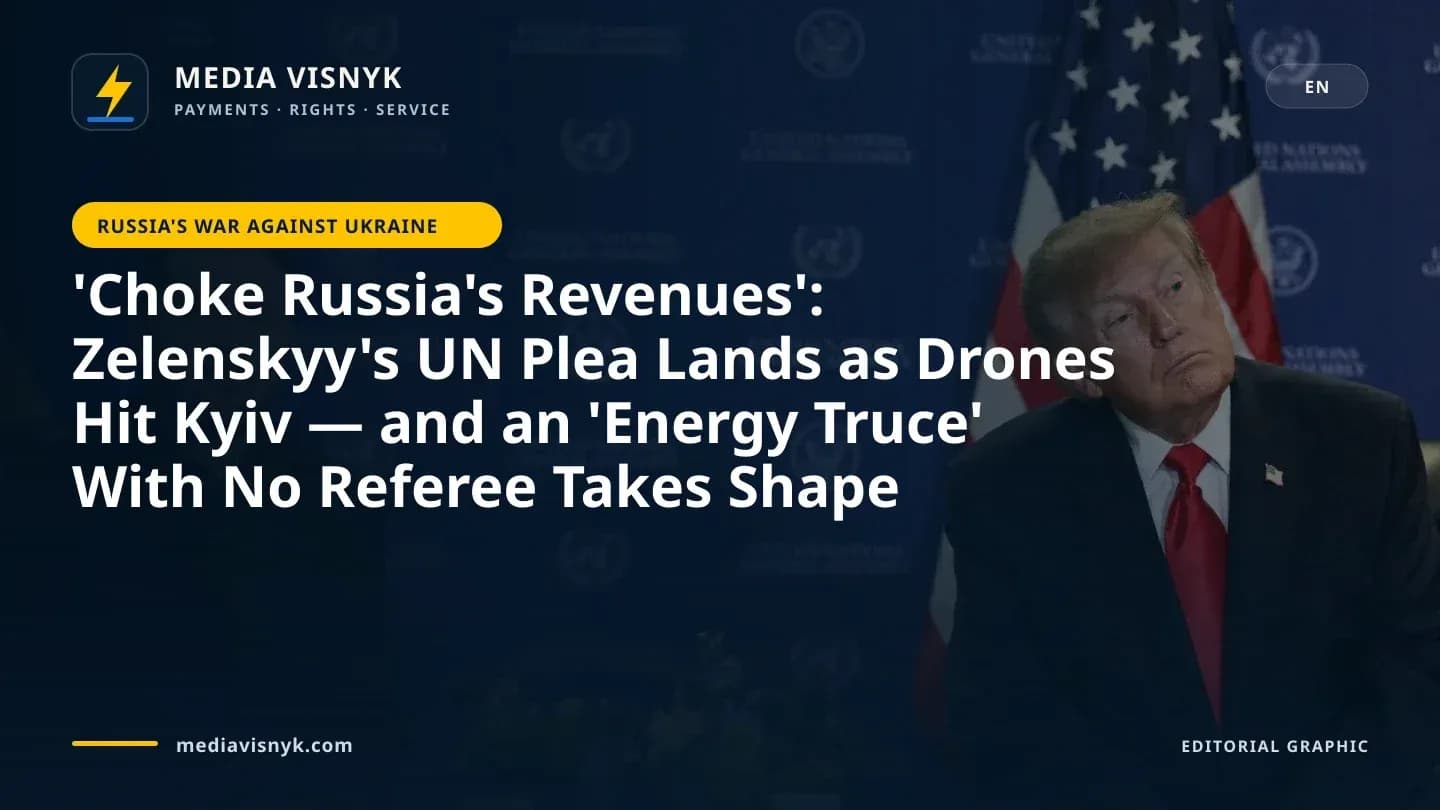
Zelenskyy urged the UN to keep choking Russia's revenues as a US-carried energy truce reached Moscow with no answer from the Kremlin and no verification mechanism described by any party.
 1 / 4
1 / 4"When someone gives Russia more money through trade, they are giving this war more time," Zelenskyy told world leaders in New York.
He called Putin "Patient Zero" of a war that "keeps spreading." And he offered a number: 63,000 strike drones of various types, he said, have been used by Russia against Ukraine this year alone. That is a Ukrainian claim, but the scale matches what Western observers have been recording.
The message of the speech was blunt: this is no longer just "Ukraine's problem." Fuel prices, deadlier drones, airspace violations across Europe — the war's effects are leaking beyond the front line. Choking Russian oil income, in Kyiv's framing, is not charity for Ukraine. It is self-protection for everyone else.
That same morning, Kyiv experienced the argument firsthand.
Russian drones struck the city in daylight — a rarity, since most attacks come at night. The targets: two gas-station complexes, including one belonging to the national oil company Ukrnafta, and warehouses. At least two people were killed. The wounded count started at 23 in the morning and climbed past forty by the end of the day.
Rescuers reported a "double-tap" — a second strike on the same site while emergency crews were already working the fire. It is a tactic documented more than once: the first munition draws in rescuers, the second hits them.
Now for the strange part of the day.
On Tuesday, September 22, Zelenskyy met Donald Trump on the sidelines of the General Assembly for roughly 40 minutes. The outcome: the United States agreed to carry a reciprocal energy-truce proposal to Moscow. Ukraine stops striking Russian refineries — Russia stops hitting Ukraine's power grid.
Zelenskyy's formulation was refreshingly honest: "If they don't want us hitting their refineries, they shouldn't touch our energy system."
In other words, this is not a concession. It is a trade. And this is exactly where the logic starts to crack.
First, it has been tried. Trump publicly announced that Russia and Ukraine had "agreed" to halt strikes on energy targets. The next day, Russian drones hit gas stations in Kyiv and Ukrainian drones hit a Russian refinery. The truce, as Reuters dryly noted, "evaporated."
Second, the Kremlin has already responded — not to the idea, but to the price. On September 15, the Kremlin "welcomed" the energy-truce concept and immediately tied it to a demand for sanctions relief. Not "yes," but "yes, if."
Third, Foreign Minister Sergey Lavrov drew a line at the UN Security Council on September 23: Russia is ready to talk about a "durable peace," but not a "pause." A pause, he argued, would only give Ukraine and its partners time to rearm. In plain language: Moscow does not want to stop the war — it wants to freeze it on favorable terms, or squeeze harder in winter.
Which raises the question nobody has answered: how would this truce even be verified?
What counts as an "energy facility"? A refinery, obviously. What about the gas stations hit in Kyiv? A port oil terminal? A power line feeding a defense plant? The terms are being written by people far from the front — and they will be interpreted by those on it.
Experts cited by Al Jazeera warn directly that the Kremlin will "exploit the ambiguities" of an energy truce — claiming Ukrainian violations and using them as justification. No verification mechanism — observers, hotlines, agreed definitions — has been publicly described by any of the three parties. Not Kyiv, not Washington, not Moscow.
That is not a detail. That is the entire substance of the deal. A ceasefire with no way to establish who fired first is not a ceasefire. It is a propaganda arbitration.
Why is Trump pushing it? Look at the numbers, not the rhetoric.
Ukraine's campaign against Russian oil refining has become one of the most effective of the entire war. By The Independent's estimate, all but 5 of Russia's 32 large refineries have been hit by Ukrainian drones, with damage estimated at around $20 billion. That is an estimate, not an audit — but the trend is documented: the Ryazan refinery, one of Rosneft's largest, halted operations after a September 6 drone attack, confirmed to Reuters by two industry sources.
The consequence is a global spike in diesel prices. For Trump — facing midterm elections in November — expensive fuel is not geopolitics. It is domestic politics. So Washington is pushing a deal that would relieve the price pressure, while simultaneously squeezing buyers of Russian crude.
On September 16, the US House of Representatives passed the "Sanctioning Russia and Iran Act," a tariff mechanism targeting countries that purchase Russian oil — above all China and India. The US Treasury has already granted India a 30-day waiver on purchases as a "temporary measure." Threaten and grant a reprieve at the same time: classic sanctions diplomacy.
What does all this mean for Ukraine in practice? Winter. Zelenskyy has asked Washington for a Patriot package from US stockpiles for the heating season, offering a swap: Germany would deliver 600 Patriots in 2027–2028 under a separate deal. Trump has not agreed. Without air defense, any "energy truce" is just words on paper — words Russia can use while it finishes off substations.
What happens next? As of the morning of September 25, Moscow has given no official response to the delivered proposal. Lavrov addresses the General Assembly on September 26 — standing in for Putin, as usual. That speech will show whether the "energy truce" has any life in it, or whether it joins the list of ideas Moscow has welcomed — and buried in caveats.
For now, the tally of September 23 stands: two dead in Kyiv, more than forty wounded, a shopping center on fire in Zaporizhzhia — and a peace proposal that both sides appear ready to interpret on their own terms.
Primary sources
Documents and statements this story is based on.
- Russia pounds Kyiv with drones, killing 2 and wounding 23, hours before Zelenskyy's UN address
- AP original: Ukraine-Russia war finances and Zelenskyy's UN address
- Russia hits Kyiv petrol stations, kills one
- Zelenskyy says he discussed energy truce, efforts to end Russia war with Trump
- Kremlin welcomes Trump's idea of energy truce with Ukraine, calls for sanctions removal
- Russia's Ryazan oil refinery has stopped operations after Sept 6 drone attack
- Russian drone attack hits Kyiv gas stations, warehouses, officials say
- Trump pushes Russia-Ukraine energy truce: Can it work?
- Zelenskyy says Ukraine ready for energy truce with Russia after Trump talks
- US tariffs against Russian oil buyers pass: What it means for China
- Ukraine offers reciprocal energy truce as US carries proposal to Moscow
- Ukraine offers Russia deal: stop hitting our power and we stop hitting your refineries; US will pass it to Moscow
- Russian Offensive Campaign Assessment, updates September 2026–present
- The Independent — Ukraine drone attacks on Russian oil refineries
- US Treasury grants India 30-day waiver on Russian oil purchases
- UN General Assembly live: Iran, Ukraine — September 23, 2026

10,000 AI-Guided Hornet Drones in Three Months: The War of Autonomous Weapons Has Already Started — and It Isn't Entirely Ukraine's
The Day Diplomacy Was Proposed, a Russian Drone Killed a 14-Year-Old Boy in His Kyiv Apartment
Trump Asks Zelensky to Stop Hitting the Russian Refineries He Says Russia Has Already 'Lost'
The CIA Chief Went to Moscow — and Ukraine Was Asked to Pause Some Strikes