
Oleshky Ceasefire: Melania Trump Brokered a Deal — But the Dates Don't Match, and There Are No Guarantees
Melania Trump announced a localized ceasefire in Russian-occupied Oleshky, but the White House and both general staffs name different start dates. No public mechanism protects civilians during the evacuation of up to 6,000 people left without food since May.
 1 / 4
For more than four months, the people of Oleshky have been without food or medicine. The last documented food delivery was May 26, 2026, according to the UN Human Rights Monitoring Mission in Ukraine. Up to 6,000 civilians remain in the city, including over 180 children. The head of the Kherson regional administration, Oleksandr Prokudin, has said that Russian forces are holding about 2,000 people as hostages, nearly 50 of them children.
Then came a breakthrough.
Melania Trump said she established a direct channel with both Moscow and Kyiv, building on her previous involvement in six cases reuniting 34 children. Now she is attempting to save an entire town.
It sounds promising. But a closer look reveals a fragile, vaguely defined operation with critical gaps.
Three Points, Zero Enforcement
Lubinets outlined three components: a ceasefire, humanitarian cargo delivery, and free movement for civilians wishing to leave Oleshky. He led the talks for Ukraine; Russian State Duma deputy Yana Lantratova represented Moscow.
None of these points come with a public enforcement mechanism.
Who stops a bullet if a local commander decides the “truce” doesn’t apply to his sector? How will aid be delivered, and who ensures it isn’t looted? Where exactly can civilians go — and will “free movement” turn into forced filtration by Russian forces?
There are no answers.
Two Dates, One Confusion
The White House stated the ceasefire would begin on October 29. But later that same day, the General Staff of the Armed Forces of Ukraine announced a ceasefire in the Oleshky area starting at 03:00 Kyiv time on October 27. Almost simultaneously, Russian Chief of the General Staff Valery Gerasimov declared a ceasefire on the Kherson direction from 04:00 Moscow time on October 27.
October 27 vs. October 29 — a two-day gap.
No official explanation has been given. It could be that October 27 marks the start of military silence, and October 29 the launch of the active humanitarian mission. It could be a simple coordination failure between political and military levels. For people waiting to evacuate, two days can be fatal.
Melania’s Role: Humanitarian or Political?
President Donald Trump confirmed the initiative was his wife’s, saying she wants to “save the children.” Kremlin spokesman Dmitry Peskov also acknowledged her coordinating role.
But does the First Lady have tools to enforce compliance? The White House said an “independent American media organization” would monitor the operation. Which one? Not specified. And can a media organization stop shelling? Rhetorical question.
Melania Trump said she first learned about Oleshky during a private conversation at an event in New York on the sidelines of the 81st UN General Assembly. The initiative came not from a systemic U.S. or international decision, but from one person’s personal desire.
That can be a strength — or a fatal weakness.
What the Sides Say
Ukraine is cautiously restrained. Lubinets called the mission “maximally difficult to implement.” The General Staff noted that units had previously delivered aid by drone and “expect that humanitarian access for the people of Oleshky will be guaranteed.” Note: “expect,” not “are certain.”
Russia — Peskov said all who wish can leave the city, and evacuation may take several days. He did not clarify whether people can go to Ukrainian-controlled territory or only toward Crimea.
The Main Risk: Russian Regrouping
The biggest concern is that Russia will use the truce to regroup forces on the Kherson front. The published agreement contains no verification mechanisms: no monitoring mission, no demarcation lines, no penalties for violations.
This is not a technical oversight. It is a potential trap.
If Russian units use the pause to bring up reserves or shift positions, Ukrainian forces could end up in a worse position than before the ceasefire. A “humanitarian initiative” could turn into a strategic defeat.
Are There Precedents?
Yes, and they are discouraging. Local ceasefires in Syria, Yemen, and the Donbas have repeatedly collapsed precisely because of a lack of enforcement. The UN has repeatedly stressed the “urgent need for a localized ceasefire” in Oleshky — but the UN itself is not part of this operation.
What Happens Next?
The ceasefire has not yet taken effect. If the military general staffs are correct, it begins October 27. If the White House is correct, October 29. But even after it starts, the core questions remain: Can people leave safely? Will they get food? Will the “humanitarian window” become a trap?
And most importantly — who will be held accountable if something goes wrong?
Melania Trump did what diplomats could not: she brought the sides to the table. But a table is not peace. It is not even a guarantee that anyone will reach that table alive.
Primary sources
Documents and statements this story is based on.
- TSN — Oleshky ceasefire: all the details
- Ukrinform — Lubinets on the humanitarian mission in Oleshky
- Ukrinform — Melania Trump's announcement
- Ukrinform — AFU General Staff on the ceasefire regime
- European Pravda — Melania Trump announces a ceasefire
- Ukrinform — the UN on Oleshky
- Radio Svoboda — operation to create humanitarian corridors in Oleshky
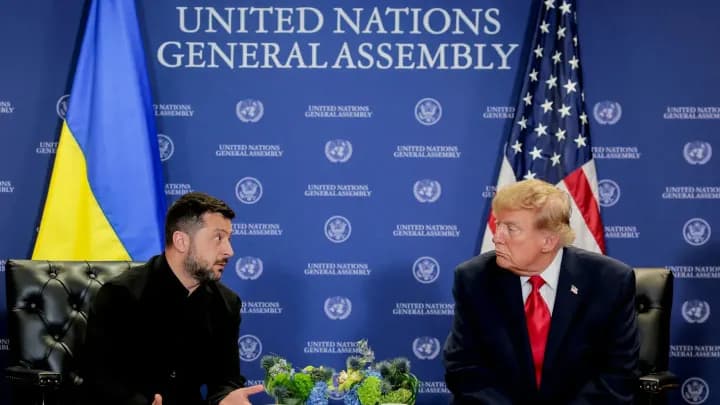
Trump Says “Someone Else” Should Negotiate for Ukraine — Witkoff Heads to Oslo, Then to Putin
1,000 Drones on St. Petersburg: Ukraine’s Largest Strike Yet as Trump and Zelensky Trade Blame
332 Drones in One Night: Vinnytsia in Blackout, Trump Waives Russia Sanctions — and Russia Strikes Ukraine’s Energy Grid
Trump Suspends "Hell Sanctions" of the Graham Act One Day Before Deadline — 500% Tariffs on Russian Oil Will Not Apply