
1,000 Drones on St. Petersburg: Ukraine’s Largest Strike Yet as Trump and Zelensky Trade Blame
Ukraine launched over 1,000 drones at St. Petersburg and the Leningrad region overnight on October 18 — the largest drone operation of the war. An oil terminal, a fuel depot, an Ozon logistics hub, and a VK data center were hit; one person was killed and five wounded. The strike came as Trump accused Zelensky of sabotaging peace and the “energy ceasefire” collapsed.
 1 / 4
Imagine more than a thousand drones swarming over St. Petersburg. That’s not a disaster movie — it’s what happened on the night of October 17-18. Ukrainian drones struck the St. Petersburg Oil Terminal, the Ruchi oil depot, an Ozon logistics hub, and even a VK data center. Russia’s Defense Ministry claimed to have shot down 1,015 drones across 15 regions, Crimea, and the Black Sea between 8 p.m. Saturday and 8 a.m. Sunday. But how many got through to their targets is unclear.
What is clear: one person died, five were wounded, 12 apartment buildings and two private houses were damaged in St. Petersburg alone. Pulkovo Airport was shut for over six hours, 27 flights canceled, 46 delayed, 13 diverted. In the Leningrad region, a woman and three children were hospitalized with carbon monoxide poisoning after drone debris hit their home. About 20,000 people lost power in the village of Yanino.
This is the largest Ukrainian attack on Russian soil since the full-scale war began. And it didn’t happen in a vacuum.
Just a week earlier, on October 11, President Trump suddenly announced an “energy ceasefire” between Russia and Ukraine on his Truth Social platform. The problem: neither Kyiv nor Moscow seemed to know about it. Zelensky said, “This is news to me.” Russia stayed silent. Within days, The Guardian reported the initiative had collapsed.
Zelensky insists that since the supposed ceasefire, Russia has struck Ukraine’s energy infrastructure 76 times. So there was no pause — from either side.
But the real explosion wasn’t in St. Petersburg — it was in the public feud. On October 18, Trump wrote: “Zelensky doesn’t want to end the war. His strikes on oil refineries are a disgrace that raises global oil prices.” He added that he was halting new sanctions on Russia so as not to push Moscow away from negotiations.
Zelensky fired back in an NBC interview, claiming the U.S. had paused intelligence sharing with Ukraine for three days, and that betting on Putin’s side would be a “historic mistake.” Secretary of State Marco Rubio immediately denied any pause, saying Zelensky “doesn’t know what he’s talking about.” Rubio also confirmed that Starlink speeds had been reduced and then restored, but claimed no one ordered it — “it just somehow happened.”
So here’s the central question: Who actually wants peace, when Kyiv launches record drone strikes on Russia while Washington lifts sanctions on the Kremlin and blames the Ukrainian president? The uncomfortable answer: neither side seems to. Both are playing their own games — and ordinary people are paying the price.
In St. Petersburg, residents woke up to shattered windows and burning oil terminals. In Ukraine, Russian missiles keep hitting power plants. The “energy ceasefire” was a fiction from the start, buried by both sides.
What’s changed is that Ukraine has shown it can reach Russia’s second city with overwhelming force. That’s a signal not just to Moscow, but to Washington: Kyiv won’t be constrained by anyone’s timetable. But the risk is that this escalation, combined with a breakdown in U.S.-Ukraine trust, plays straight into the Kremlin’s hands.
Peskov called the attacks “the latest manifestations of agony.” The real agony, however, may be that neither Trump nor Zelensky is willing to blink — and the war grinds on.
Primary sources
Documents and statements this story is based on.
- Al Jazeera — Ukraine launches over 1,000 drones at Russia
- CBS News — Ukraine strikes St. Petersburg oil facilities
- BBC News Russia — Attack on St. Petersburg
- SOFX — Ukraine strikes St. Petersburg oil terminal
- Interfax — Attack on the St. Petersburg Oil Terminal
- DP.ru (Business Petersburg) — Drone Attack on St. Petersburg
- Fontanka — Drone Attack
- Euronews — Marco Rubio denies intelligence pause
- Reuters — Ukraine will halt strikes if Russia stops energy attacks
- The Guardian — US effort to get Russia-Ukraine energy ceasefire collapses
‘Software Glitch’ Costs a Life: US Again Failed to Warn Kyiv of Ballistic Strike
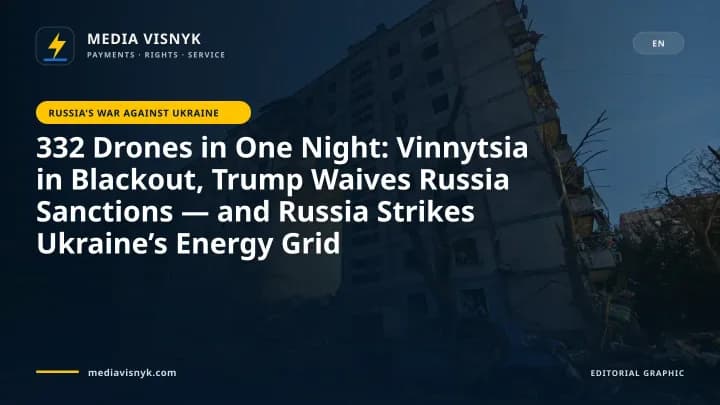
332 Drones in One Night: Vinnytsia in Blackout, Trump Waives Russia Sanctions — and Russia Strikes Ukraine’s Energy Grid
Trump Suspends "Hell Sanctions" of the Graham Act One Day Before Deadline — 500% Tariffs on Russian Oil Will Not Apply
"Zelenskyy is not the person": Trump publicly disavows Ukrainian president, says Putin is easier to deal with