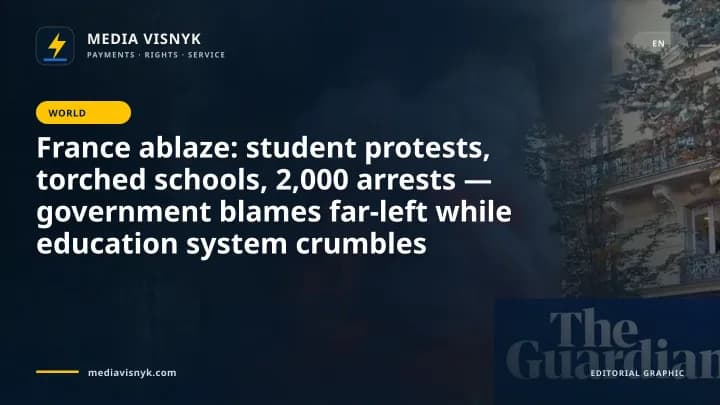
Lost hand, 500+ schools shut: France’s biggest student protests in 50 years turn deadly
A 15-year-old lost his left hand to a police stun grenade in Lens. Over 250,000 protesters, 6,000 arrests, 500+ schools shut: France is facing its biggest youth protests since 1968 — and the government is running out of answers.
 1 / 4
1 / 4What happened
On October 5, in the town of Lens (Pas-de-Calais department), a 15-year-old student approached a police sting-ball grenade that had not detonated. He picked it up — and it exploded in his hand. The teenager lost his left hand and part of his forearm.
Pas-de-Calais prefect François-Xavier Loch confirmed the incident but immediately added that about 200 protesters had been throwing stones, fireworks, and “mortars” at police before the grenade was used. The boy’s life is not in danger, the prefect said.
A witness who was standing next to the victim told local newspaper La Voix du Nord a different story: the boy did not pick up the grenade — it exploded nearby. The General Inspectorate of the National Police (IGPN) has opened a criminal investigation to determine what actually happened.
This is not an isolated case. Eden, 14, from Saint-Ouen-l’Aumône, suffered a “double fracture of the jaw” after being hit by a tear gas grenade. His mother says her heart is “broken”: his jaw is wired shut, and he can only eat through a straw. Interior Minister Laurent Nuñez announced an investigation, and a police officer has been charged.
The scale: this is not “kids fooling around”
The protests are now in their third week. It all started at the Lycée Saint-Exupéry in Créteil, a Paris suburb. Students demanded teachers — who were simply not there. Within days, the wave swept across the Île-de-France region and then the entire country.
As of October 6:
– over 250,000 protesters took to the streets, including 56,000 in Paris; – more than 6,000 people have been arrested since the protests began; – 87% of those arrested are minors; over 1,800 face legal proceedings; – 215 students and 85 staff members have been injured (according to the prime minister); – over 600 police officers have been injured; – 24 schools have been burned or ransacked (education minister’s statement on October 4); – 78 school staff members have been injured since the start of the protests.
On Monday October 5, Education Minister Édouard Geffray reported 589 disrupted schools. For comparison: on Friday October 2, there were 735 out of 3,700 schools in France. Figures vary by source, but the trend is clear — the country is paralyzed.
Why this happened: not just grenades, but empty classrooms
The protests did not emerge from nowhere. In the 2024–2025 academic year, nearly 10% of teaching hours in French public secondary schools were not delivered. 7.5% of lost hours were due to the inability to find substitute teachers.
That means one in ten lessons in a French school simply never happened. Students sat in empty classrooms. Teachers burned out. Administrations shrugged.
Minister Geffray admitted: “One of the difficulties of this movement is the absence of nationwide demands — it all started with local demands.” In other words, problems accumulated for years in each individual school — and exploded simultaneously across the country.
The government’s position: “violence has no place,” but grenades are okay
Prime Minister Sébastien Lecornu stated that “violence cannot have a place” in the protests. At the same time, he acknowledged that “accidents happen,” effectively justifying police actions. He promised a “political response” to students’ concerns.
The education minister announced the creation of a “large consultation platform” for students. And set a deadline — October 16. He hopes to resolve “most problematic situations” by that date.
Jean-Luc Mélenchon, leader of La France Insoumise, called the protests “the most powerful youth movement of high school and university students” since 1968. The SNES-FSU teachers’ union urged members to join the protests. The Union Syndicale Lycéenne (USL) student union is coordinating nationwide actions.
What’s next
The prime minister convened a crisis meeting on October 6. The education minister promises a dialogue platform. But on the streets — 250,000 people, most of them minors. And the October 16 deadline is not a plan; it’s a date.
The question remains: is the French government ready to listen to its children before the next grenade explodes in someone’s hands?
Or, more precisely — is it capable of listening without grenades?
Primary sources
Documents and statements this story is based on.
- BBC News — Schoolboy loses hand in French protest
- TIME — France Student Protests
- The Guardian — Schools closed, 24 burned
- Reuters — Student loses hand
- Al Jazeera — France student protests
- France 24 — Student protests live
- Euronews — 400-500 schools closed
- Politico.eu — Lecornu defends police
- Le Monde — French PM says violence will not be tolerated