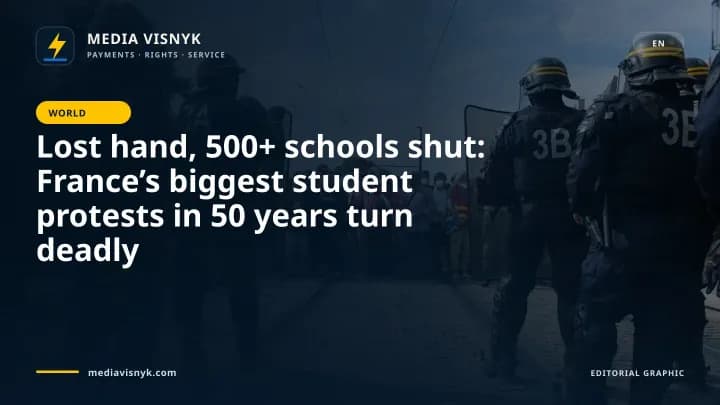
France in Flames: 2,400 Arrested, Historic Limoges Town Hall Burned as Cost-of-Living Protests Trigger Bond Market Selloff
France's largest protests since the gilets jaunes left the historic Limoges town hall burned, 1,500 shops looted and over 2,400 arrested. On October 19, French bonds and stocks sold off sharply, and Macron is caught between the markets and the street.
 1 / 4
The street speaks in fire
On Saturday, October 17, France saw its most violent protests since the gilets jaunes. The Interior Ministry put the nationwide turnout at around 550,000; unions and student groups claimed up to 800,000. The trigger: soaring prices for food, utilities and fuel, compounded by what protesters describe as a collapse in public school infrastructure.
But the scale is not the story. The violence is.
In Limoges, rioters set fire to the city's town hall — a neo-Renaissance building dating to 1883, listed as a historic monument since 1975. The roof collapsed, the clock tower was destroyed. Mayor Guillaume Guerin called it a "clear, premeditated intention to burn the town hall." He added a telling detail: no national police officers were guarding the building. The repair bill is estimated at over $1 million.
Nationwide, some 1,500 shops were damaged. Carrefour CEO Alexandre Bompard gave that figure publicly — and it only covers what major chains have counted so far. More than 600 police officers, gendarmes and firefighters were injured. At least two deaths have been linked to the protests: a protester who suffered a heart attack near Paris, and a 22-year-old police officer hit by a car in Nantes.
Macron's response: blame the radicals
In a televised address on Sunday evening, Macron condemned "unbridled violence" and blamed "far-left radical groups" and "criminal elements." He vowed: "Those who looted will pay for the damage; those who tried to overthrow the Republic will be held accountable."
Interior Minister Laurent Nuñez echoed him: "The right to protest is a fundamental right. Deliberately and collectively sowing disorder through violence is not."
But behind the rhetoric lies a real crisis. Marine Le Pen called the government "exhausted, disoriented, and seemingly incapable of doing anything except commenting on its own powerlessness." Jean-Luc Mélenchon accused Prime Minister Lecornu of "playing with fire."
While politicians trade accusations, markets are voting with their money.
Black Monday: CAC 40 slides, OAT yields spike
On Monday, October 19, French equities led European losses. The yield on 10-year French government bonds (OATs) rose to 4.86% — up 8 basis points from the previous session. For context, German 10-year Bunds held at 3.41%. The OAT-Bund spread — a key gauge of investor confidence in French debt — widened to about 145 basis points.
In plain language: investors are pricing in a higher risk that France may struggle to service its debt amid political instability. Every burned shop pushes the risk premium higher.
Analysts at Capital Economics forecast the spread could reach 200 basis points by the end of 2027. Ninety One warns that if France fails to pass a 2027 budget, the deficit could exceed 6% of GDP — more than double the EU's 3% limit.
Italy catches the fire
The unrest has spread beyond France. In Milan, rioters looted the Galleria Vittorio Emanuele II. In Bologna, 56 police officers were injured; in Turin, around 100. Prime Minister Giorgia Meloni condemned "gangs of hooligans." But the root cause is shared across Europe: a cost-of-living crisis that no government has managed to contain.
Where is the ECB?
So far, the European Central Bank has remained silent. Analysts say the ECB is unlikely to intervene unless the selloff becomes a market dysfunction rather than a reflection of France's real fiscal problems. That leaves Paris to face its creditors alone.
What comes next?
Macron has instructed prefects to consider banning protests where necessary. A state of emergency has not been declared. But if the protests continue and the bond selloff deepens, the government will face a brutal choice: cut spending (and fuel more anger) or keep borrowing (and lose market confidence).
France is the eurozone's second-largest economy. What is happening there now is not just a domestic crisis. It is a stress test for the entire European Union. So far, the test is not going well.
Primary sources
Documents and statements this story is based on.
- AP/CityNews Toronto — Paris police report 855 arrests after violent clashes and looting during protests
- Business Insider — France protests riots Paris bond market debt OATs yields selloff
- SOFX — Rioters destroy historic French town hall as nationwide arrests pass 2000
- Reuters — French stocks slide after violent protests (original, not read)
- Reuters — France's Limoges fire-ravaged town hall rekindles memories of Notre Dame (original, not read)
- The Guardian — France hit by debt sell-off as protests unnerve investors (original, not read)
- AFP — Macron denounces unbridled violence as France hit by new clashes (original, not read)