
Europe on Fire: 410,000 March in France, Nearly 1,000 Arrested as Cost-of-Living Revolt Engulfs the Continent
410,000 people marched across France on October 24 — the second wave of protests in a week — with nearly 1,000 arrested. Italy, Spain, Belgium, Portugal, and Albania saw simultaneous unrest as the Iran war pushed Brent crude to $116 a barrel and the cost of living ignited a continent-wide revolt.
 1 / 4
France is burning — again. On Saturday, October 24, the country saw its second wave of mass protests in a week, and the numbers are staggering. The Interior Ministry counted 410,000 demonstrators nationwide, with 110,000 in Paris alone. The CGT union puts the figure at nearly double: 800,000. The gap between official and union estimates is now a ritual, but even the lower number signals a country in open rebellion.
Just a week earlier, on October 17, 550,000 had marched, over 2,700 were arrested, roughly 3,000 shops were damaged, and losses ran into the "hundreds of millions of euros," according to the French Chamber of Commerce.
The government's response? A massive security operation: 70,000 police officers, helicopters, water cannons, and armored vehicles deployed nationwide. Interior Minister Laurent Nuñez reported "nearly 1,000 arrests" by the end of the day, adding that the number would rise.
Paris: Tear Gas, Water Cannons, and 64 Arrested
In the capital, police conducted over 3,000 preventive checks. Sixty-four people were arrested — six of them minors — and 40 were placed in custody. Nuñez claimed "several thousand radical activists" were in the march's tail, with around 500 identified as troublemakers. The arsenal seized included metal ball bearings, lead shot, fireworks, slingshots, steel balls, brass knuckles, and air guns.
Two people were seriously injured: a 20-year-old man lost fingers in Toulouse, and another was hurt in Clermont-Ferrand. In Marseille, 51 were arrested. In Orléans, 11,000 to 13,000 protesters turned out against Marine Le Pen's National Rally party congress.
"You're silencing us. They're taking our money, heavily taxing us, and we can't say anything," 26-year-old protester Zelie told the BBC. "Today we're on the streets because it's gone on too long, for too many."
Italy, Spain, Belgium, Portugal: A Chain Reaction
France is the epicenter, but the earthquake is continental.
Italy deployed 500 soldiers to Milan after last week's riots. On October 24, nine people were arrested and 371 detained — 110 of them minors. Police used water cannons in Rome. Protesters in Milan told the BBC: "The cost of living... We barely make it to the end of the month" — citing high rents and fuel prices.
Spain: Over 100 arrested in Barcelona following student protests.
Portugal: Police cleared a protest camp in Lisbon on October 25, arresting at least 55 people. The demonstrations are driven by a severe housing crisis.
Belgium: Student protests in Brussels and Liège against a €1,200 tuition fee hike.
Albania: Police used tear gas against anti-government demonstrators in Tirana.
Six countries. One week. One common denominator: the cost of living.
Oil at $116: Who Pays for the Iran War?
The engine behind this unrest is energy. On October 23, Brent crude closed at $116.72 a barrel — a six-month high — driven by the ongoing war in Iran. None of the sources provide exact domestic fuel or electricity prices for each country, but the chain is clear: when oil jumps by a third, ordinary people pay at the pump and in their utility bills. Governments then cut education and healthcare budgets, and the street explodes.
France's government responded not with social packages but with 70,000 police and fast-track courts. Hundreds have already been sentenced for vandalism, arson, and looting under expedited procedures.
Is This the End of Europe's Winter of Discontent?
The first wave on October 17 showed that the government is ready for a crackdown. The second wave shows that the protesters are not intimidated. France's prime minister urged the public not to "conflate" looters with peaceful demonstrators, but on the ground, police make little distinction.
Marine Le Pen has already launched her presidential campaign. Her party congress in Orléans on October 24 was met with an 11,000-strong counter-protest. Street tension is spilling into politics — and it will shape the 2027 elections.
The question is not whether the protests will subside. The question is whether Brussels and national capitals will listen. So far, the answer is 70,000 police, 1,000 arrests, and zero promises to bring prices down.
Europe is heading into a winter where the streets will be heated not by gas — but by rage.
Primary sources
Documents and statements this story is based on.
- BBC News — France protests: Second wave of demonstrations draws 410,000
- BBC News Live — France protests October 24
- CBS News / AP — Paris protests: 110,000 march, new riots
- The Guardian — Milan luxury shops close, Italy to deploy troops
- CNBC — Oil price: Brent hits $116.72 on Iran war
- Le Monde — Italy, Spain, Belgium, Portugal: social unrest spreads across Europe
- DW — Portugal housing crisis protests
- France 24 — France deploys 70,000 police
- PBS — More than 400,000 protest across France
- The Guardian — France police demonstrations civil unrest

Trump’s Approval Rating Hits Record Low of 31% Two Weeks Before Midterms — Democrats Lead by 12 Points. What Does It Mean for Ukraine?

France in Flames: 2,400 Arrested, Historic Limoges Town Hall Burned as Cost-of-Living Protests Trigger Bond Market Selloff
Vance draws red line for Iran: cut enrichment or no end to war. Tehran fires back — 'never'
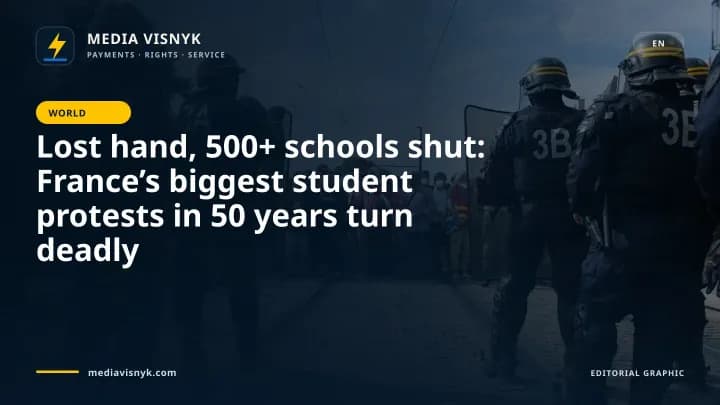
Lost hand, 500+ schools shut: France’s biggest student protests in 50 years turn deadly