
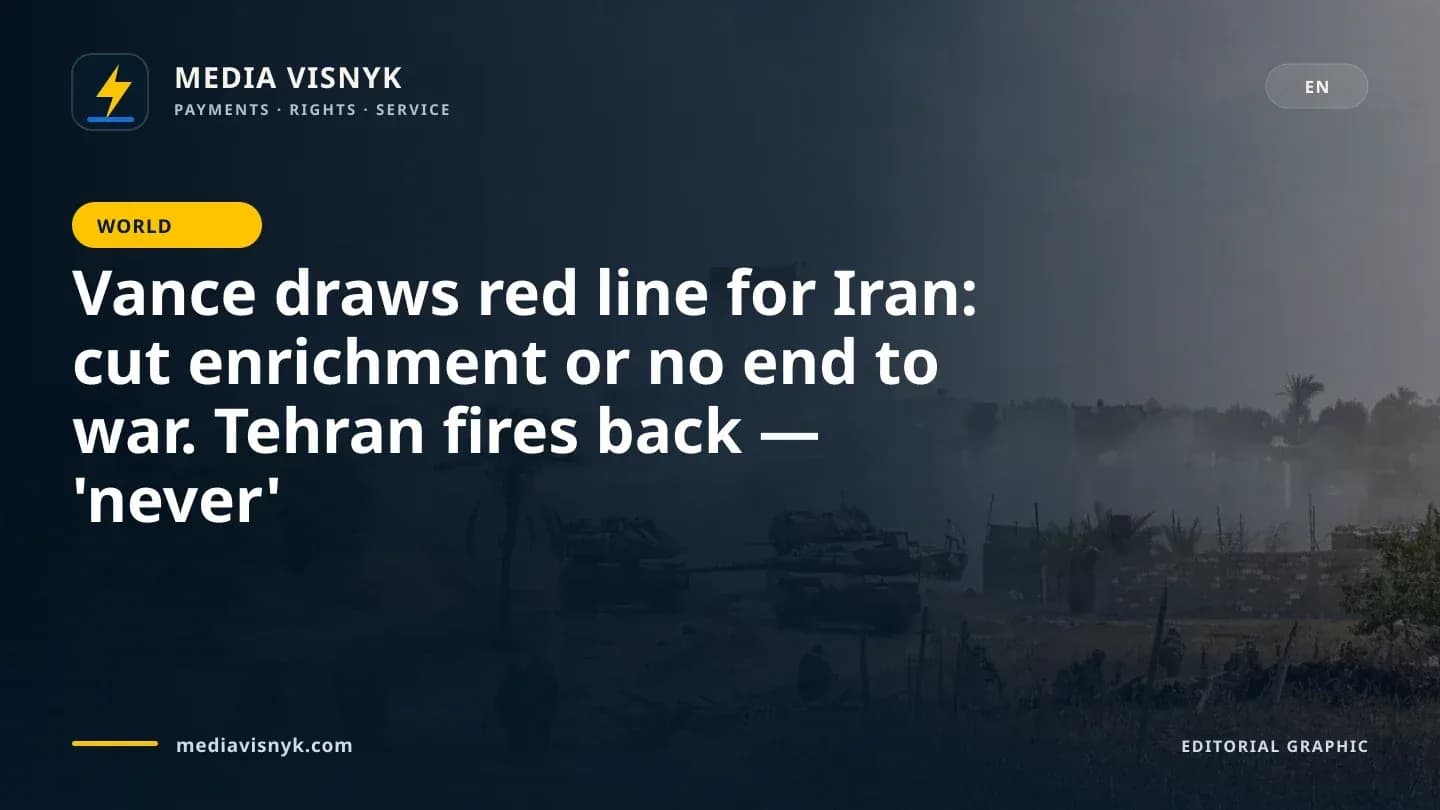
Vance draws red line for Iran: cut enrichment or no end to war. Tehran fires back — 'never'
US Vice President JD Vance has publicly set Washington's condition for ending the seven-month war with Iran — a "meaningful" cut in enrichment capacity. Tehran refused within hours, leaving the diplomatic endgame deadlocked as Brent crude trades above $101.
 1 / 4
1 / 4On Monday, October 6, 2026, Vice President JD Vance sat down with Reuters in Fairbanks, Alaska, where he was campaigning ahead of the November midterm elections. And he said what many had been waiting months to hear: a clear, public condition for ending the war.
"If you don't want nuclear weapons, why do you need 60% enriched fuel?" Vance asked, referring to the enrichment level Iran had reached before the conflict. Then he added a sharp warning: the US "will not trade words for actions."
The phrase "meaningful reduction" is deliberately vague. Vance did not specify numbers — whether a return to the 3.67% civilian standard, a freeze at 20% and 60% programs, or the dismantling of centrifuges. This gives Washington negotiating flexibility — but also makes the demand hard to verify.
Iran responded almost immediately. An anonymous senior official in Tehran told Moneycontrol: "We will never give up our right to enrichment. Talks with Washington on the nuclear program are not currently underway."
As of today, the two positions look like parallel lines that do not intersect.
The cost of war — and who pays
Operation Roaring Lion, launched by the US and Israel on February 28, 2026, has now been running for seven months. According to Vance, it costs American taxpayers $3 billion per month in direct military spending alone — not counting the economic fallout for global markets.
The Strait of Hormuz, through which roughly 20% of the world's oil passes, remains partially blocked. Brent crude traded at $101.51 per barrel on October 7, 2026. Before the war, prices hovered around $75–80. Every additional dollar per barrel means direct losses for oil-importing countries — including Ukraine, which relies on imported petroleum products.
Who runs Iran — an open question
One of the most telling moments in Vance's interview was his admission that Washington does not fully understand who actually makes decisions in Tehran after the elimination of Supreme Leader Ayatollah Ali Khamenei on the first day of the war.
The US is negotiating with President Masoud Pezeshkian and Foreign Minister Abbas Araghchi. But, as Vance cautiously put it, "it is unclear what real power they hold." Iranian Foreign Ministry spokesman Esmail Baghaei responded on October 5 by saying the US "knows very well who its interlocutor is" and that the problem lies in "contradictory positions and contradictory signals from American officials."
A diplomatic mirror: each side accuses the other of inconsistency.
What comes next — elections, escalation, or compromise
President Donald Trump, according to Reuters, has already rejected Tehran's latest proposal and warned that military operations could intensify after the November midterm elections.
This creates a clear timeline: diplomacy has a window until November. If Iran does not agree to a "meaningful reduction" — and so far it refuses even to discuss the topic — the US is likely to increase military pressure.
Vance previously brokered a tentative peace deal in June 2026, which, by his own account, "quickly fell apart." A repeat scenario looks entirely plausible.
The oil dimension
For Ukraine, which imports refined petroleum products, the situation in the Strait of Hormuz is not abstract geopolitics. Every spike in Brent prices means higher fuel costs at the pump, rising logistics expenses for businesses, and additional pressure on the state budget.
If the war continues and the strait remains partially blocked, prices could climb further. If Iran accepts Vance's conditions — which currently appears unlikely — markets would get relief.
For now, the stakes are clear: Washington demands concessions, Tehran refuses, the war grinds on, and oil gets more expensive. Neither side shows any willingness to blink.
Primary sources
Documents and statements this story is based on.
- Devdiscourse (Reuters syndication) — Exclusive: In interview, US Vice President Vance says Iran must cut enrichment to end war
- The Jerusalem Post — Iran News Live Updates, October 7, 2026
- Moneycontrol — Iran rejects JD Vance's nuclear demands
- The Independent — Iran-US war live: Trump warns of 'not so nice' end
- Reuters (original interview — confirmed via syndication)
Three Years After October 7: How a Single Attack Turned the Middle East Into a Multi-Front War With No End in Sight
Trump-Appointed Judge Orders White House to Restore Access for CNN, MS NOW and Politico — but It's a 14-Day Win
Trump welcomes Xi at the plane's steps: the trade truce is extended by two months — but no one says what was traded for it
CNN, MS NOW and Politico sue after White House access ban