Trump welcomes Xi at the plane's steps: the trade truce is extended by two months — but no one says what was traded for it
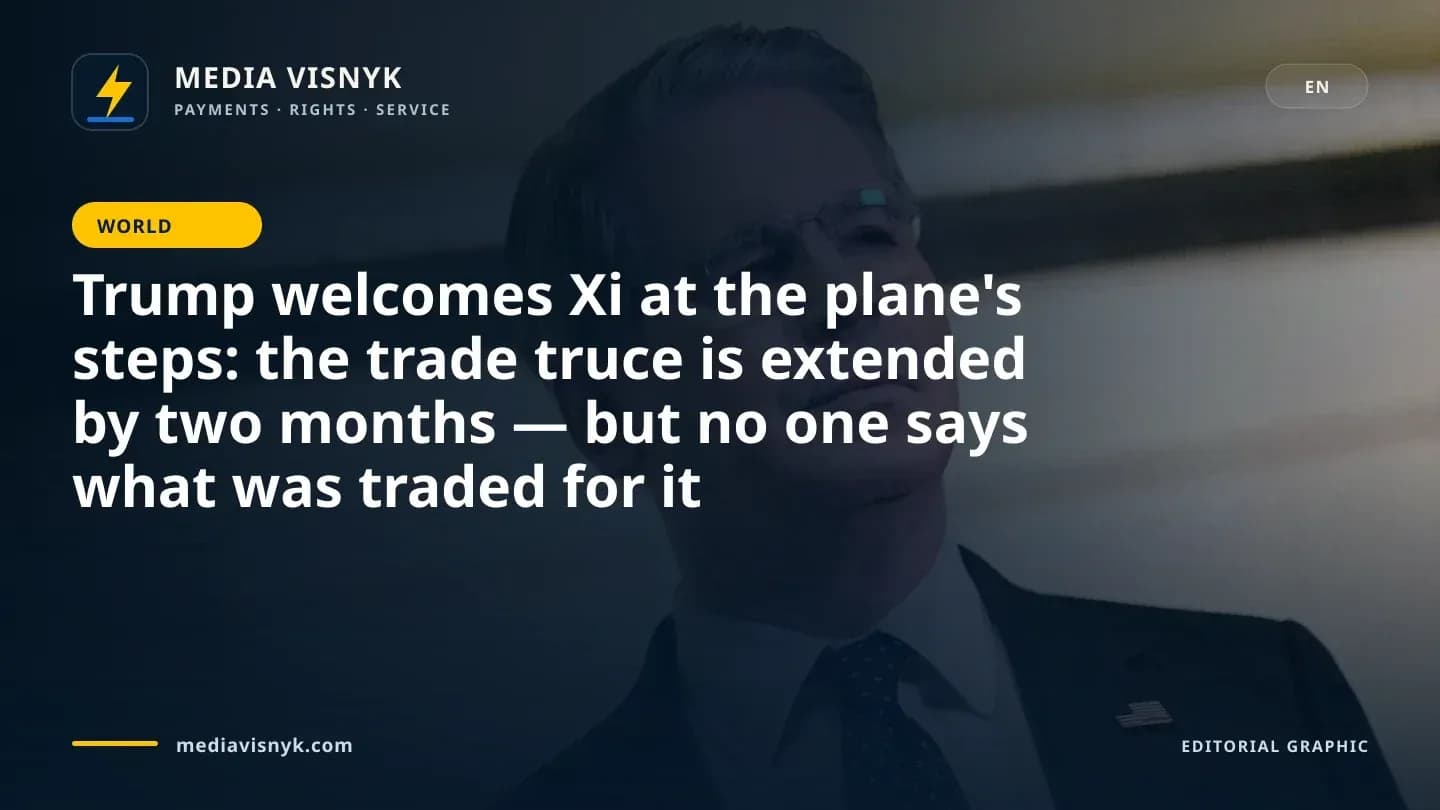
Xi Jinping arrived in Washington for his first US state visit in over a decade, and Trump greeted him planeside. Bessent announced the US-China trade truce extension to January 10, 2027 — but no official statement reveals what either side conceded for the two-month pause.
 1 / 4
1 / 4On Wednesday, September 23, 2026, China's President Xi Jinping set foot on American soil. It was his second state visit to the United States — the first came back in September 2015. Counting all trips, it is his fifth visit to America since 2012, and he had not been in the US for almost three years before this one.
Trump did something he does not do for every guest: he drove out to the aircraft himself. A planeside welcome is a rare protocol gesture, and both governments framed it as a sign of respect. Beijing noticed — official Chinese readouts singled out the ceremony.
But the ceremony is scenery. The substance is in one number.
"Two more months"
Treasury Secretary Scott Bessent announced on the day of Xi's arrival that the US and China agreed to extend their trade truce until January 10, 2027. That extends the existing arrangement known as the Busan agreement, struck in October 2025 when the two leaders met in Busan, South Korea.
Here is what that deal was. Trump cut tariffs by 10 percentage points and paused export restrictions on thousands of items. China, in return, resumed purchases of American soybeans and suspended its own export controls on rare earth metals — materials without which modern electronics, electric vehicles and military hardware simply cannot be produced.
So the truce is not peace. It is a pause. China's export controls on rare earths were not lifted, only frozen. Analysts at CSIS and Geopolitical Monitor describe the arrangement as fragile: the disputes were not resolved, merely postponed.
And that brings us to the question the White House has not answered.
What was the price?
Bessent says the extension buys time for a "bigger deal." Convenient phrasing. But no official statement lists a single concession: what the US gave, what China gave, whether there were any new conditions at all. Only the extension itself was announced.
This matters for a simple reason. If one side paid more for two months of calm, readers should know which one. If nobody paid anything, then this is not diplomacy — it is an alarm clock with the snooze button pressed, set to ring on January 10.
Before the summit, US Trade Representative Jamieson Greer blamed Beijing for the "uncertainty" around the extension, citing friction over rare earths. China has not responded in detail. In other words: one side's claim, unconfirmed and unchallenged.
What comes off the table while the cameras film the carpet
On Thursday, September 24, Trump and Xi meet at the White House — their third face-to-face meeting in a year. The stated agenda: trade, artificial intelligence, Iran and Taiwan.
And this is where the story gets uncomfortable.
Trump has publicly described a $14 billion arms package for Taiwan as a potential "negotiating chip" in his talks with Xi. Read that sentence again. The leader of a country formally committed to helping Taiwan defend itself is describing that help as a bargaining card to play with Beijing. For Taiwan, this is not an abstraction: Xi has recently intensified military pressure around the island.
As for AI, US export controls on advanced chips remain one of the sharpest points of contention — but there is no indication in open sources whether any easing is even on the table. Analysts cited by The Guardian expect climate issues to be skipped entirely.
What does not exist yet
There is no joint communiqué from the summit as of this writing. There is no list of topics the two sides agreed to keep off the joint agenda — only a pattern of what official statements avoid.
The picture, then, is a familiar one: red carpet, present. Planeside ceremony, present. A date on the calendar, present. An answer to "who gave up what" — absent.
On January 10, 2027, the truce expires again. If the "bigger deal" does not materialize, the world will not get stability — it will get a new countdown to another round of tariff escalation between Washington and Beijing. And no one will be able to say they weren't warned.
Primary sources
Documents and statements this story is based on.
- Politico — U.S.-China trade truce extended two months
- Nikkei Asia — US and China agree to extend trade truce until January, Bessent
- PBS NewsHour — China's Xi kicks off state visit to Washington with a rare planeside welcome from Trump
- Reuters — Trump plans grand spectacle, potentially tense Xi talks
- Reuters — How Trump, Xi went from tariff war to trade truce
- NBC News — Trump, Xi summit meet at White House amid tensions over Taiwan, trade, AI
- Al Jazeera — Trump-Xi summit: What's on the agenda, why it matters
- The Guardian — Trump-Xi summit: US-China AI, trade, Taiwan, climate
- Geopolitical Monitor — US-China trade truce redux: risks behind the Busan deal
- CSIS — Trump-Xi 2026 summits program
- Economic Times — Busan agreement explained: what the US-China trade truce means for world trade
- Times of India — Bigger deal on table: US-China extend trade truce by two months as Xi visits Washington
- Wikipedia — 2026 state visit by Xi Jinping to the United States
- World Trade Scanner — Rare earths friction threatens to stall trade truce extension ahead of Xi-Trump summit
- Washington Post — Trump is meeting with China's Xi Jinping: here are the economic stakes
- i24NEWS — Trump welcomes Xi to Washington with rare planeside ceremony; trade truce extended to January