
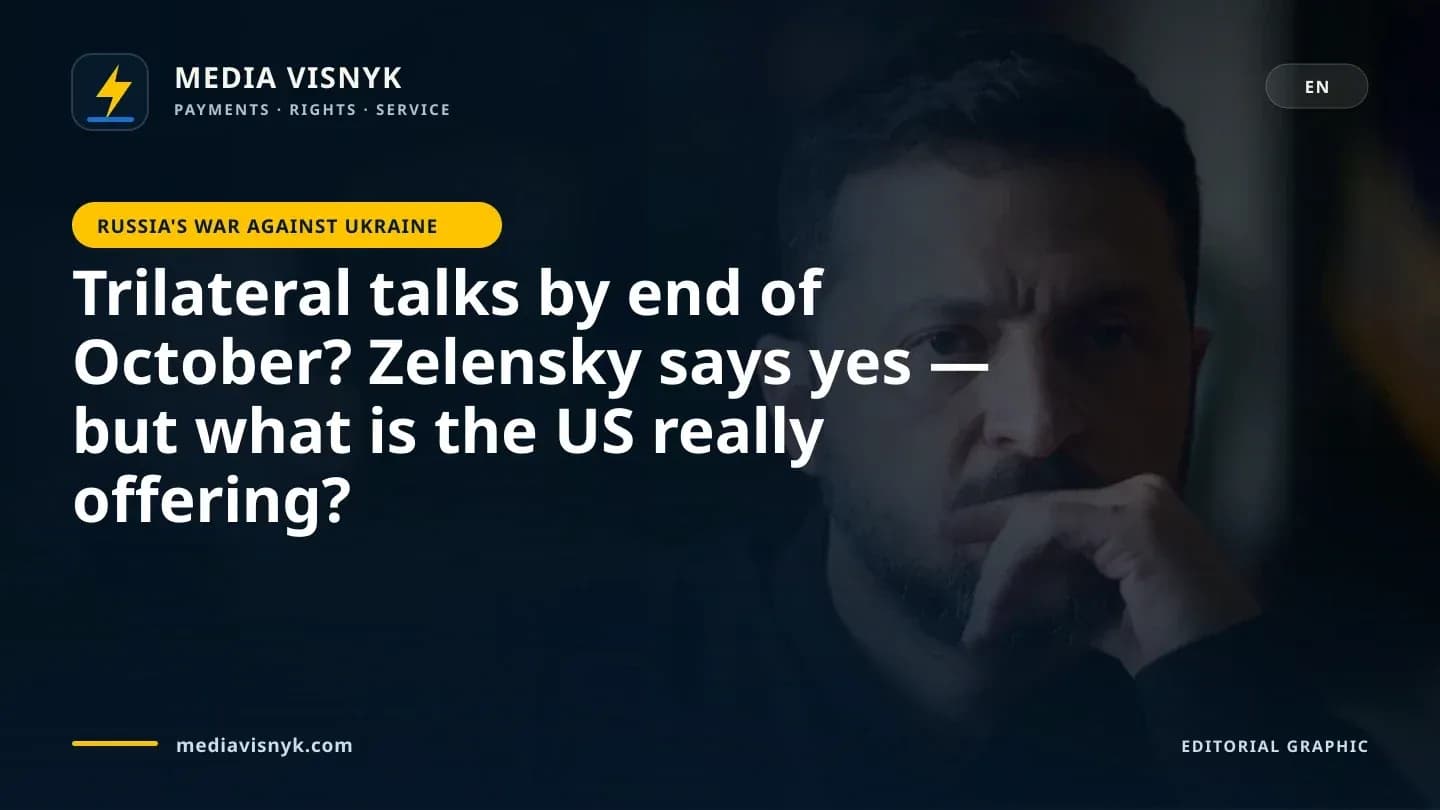
Trilateral talks by end of October? Zelensky says yes — but what is the US really offering?
Zelensky says the US has proposed a trilateral technical meeting with Russia by end of October, and Ukraine has agreed. But with no confirmation from Washington and silence from the Kremlin, the format, agenda, and Russia’s willingness remain open questions.
 1 / 4
1 / 4On the evening of October 5, President Zelensky addressed the nation. The headline was not about winter preparations, air defense contracts, or his conversation with Polish Prime Minister Donald Tusk. It was about negotiations.
“I expect that in October the American side will be able to organize a trilateral meeting. Our team is ready. Readiness is needed from Russia,” Zelensky said.
It sounds like a breakthrough — especially after nearly three years of silence on public negotiation tracks. But let’s break down what we actually know.
The first mention
Zelensky first disclosed the US proposal a day earlier — on October 4 — during a joint press conference with German Chancellor Friedrich Merz in Kyiv. He gave more detail then: “The American side is in contact with Ukraine and Russia and proposes to hold a meeting in a trilateral format at a technical level before the end of October. We have confirmed that we are open to participating in the Emirates or another country proposed by the American side.”
Key details: this is not a leaders’ summit. It’s a technical-level meeting. Not a peace treaty — an initial round of contacts. And the likely venue is the United Arab Emirates, not Geneva or Istanbul.
Question one: what exactly is the US proposing?
As of October 6, there is no official statement from the State Department or the White House confirming the trilateral meeting proposal. All information comes from Zelensky’s public remarks. That doesn’t mean the president is fabricating anything — but it means we cannot independently verify whether this is a firm US offer or preliminary consultations that Zelensky chose to make public.
What is known: on September 29, a Russian envoy was in Washington for talks with US officials. On September 22, Secretary of State Marco Rubio stated that the war cannot be ended by military means alone and that the US would seek an energy ceasefire.
So US-Russia contacts are happening. And they intensified in the fall of 2026.
Question two: what about Russia?
The Kremlin has not issued an official response to the US proposal as of October 6. Zelensky’s phrase “readiness is needed from Russia” suggests Moscow has not yet agreed — or has given a non-committal answer without public obligations.
The Russian envoy’s visit to Washington in late September signals that the Kremlin is open to contacts. But openness to contacts and willingness to compromise are different things. No public statements about concessions or a shift in Russia’s position have been made.
Question three: what will they negotiate?
The format is technical. This is not about borders, the status of Crimea, or security guarantees — at least not yet. The most likely agenda item is an “energy ceasefire” — a halt to strikes on energy infrastructure. Rubio explicitly mentioned this in September.
For Ukraine, this makes tactical sense: winter is coming, and Russian strikes on the power grid could be catastrophic. Any agreement that reduces the risk of blackouts is beneficial. But would Russia agree? Strikes on energy infrastructure are one of the Kremlin’s few remaining leverage points. Putin is unlikely to give them up for free.
Question four: what about air defense?
In the same October 5 address, Zelensky announced new contracts for air defense systems. Details — which systems, quantities, delivery timelines — were not disclosed. But the signal is clear: Ukraine is preparing for winter both diplomatically and militarily. Negotiations are negotiations, but air defense must be in place.
Question five: the call with Tusk
On October 5, Zelensky spoke by phone with Polish Prime Minister Donald Tusk. They discussed winter energy grid preparations and the trilateral talks. Poland is a key EU ally for Ukraine, and its stance on negotiations matters. Tusk has not publicly commented on the format, but the consultation itself shows Kyiv is trying to coordinate diplomatic moves with European partners.
What’s the bottom line?
The situation: the US has intensified diplomatic efforts, Ukraine has publicly confirmed readiness for a technical meeting, and Russia is silent. The format is technical, the likely topic is an energy ceasefire. Red lines have not been drawn. Conditions have not been announced.
This could be the beginning of a real negotiation process. Or it could be another round of diplomatic maneuvering — the US showing it’s “doing something,” and Russia buying time.
For Ukraine, the main risk is being pushed into concessions in exchange for promises Russia has no intention of keeping. Zelensky appears aware of this risk: he is not talking about “peace at any cost” but insisting that Russia must demonstrate readiness.
The open question remains: is the US prepared to actually pressure the Kremlin? Or will it all come down to talk of an “energy ceasefire” that Russia will break at the first opportunity?
There is no answer yet. And that is the most honest thing we can say.
Primary sources
Documents and statements this story is based on.
- Ukrinform — Ukraine agrees to trilateral technical meeting in UAE, ball is now in Russia's court — Zelensky
- Gordonua.com — Zelensky names America's key task and strong partners
- Liga.net — Zelensky: US proposes trilateral meeting with Ukraine and Russia by end of October
- Radio Svoboda — Ukraine–US–Russia talks–October
- New York Post — Russian envoy in DC for talks with US officials on Ukraine war, energy cease-fire
- President.gov.ua — Official statement by Zelensky on air defense and trilateral meeting, October 5, 2026
- Kyiv Independent — US proposes trilateral talks with Russia, Ukraine by end of October, Zelensky says
- Ukrainska Pravda — Zelensky: US proposes trilateral meeting with Russia by end of October
- 24tv.ua — Zelensky and Tusk discussed negotiations and power grid protection
- Informator.ua — President held talks with Tusk: spoke about preparations for negotiations with the US and Russia
- Yahoo News (Sky News) — Zelensky expects negotiations soon this month
- NV.ua — Zelensky announces new air defense contracts
Merz Makes Surprise Kyiv Visit with €1.3B Aid Package as Russia Strikes City Bridge
Russia hits 5th Kyiv bridge in 3 days, warns foreign diplomats to leave — analysis
The Day Diplomacy Was Proposed, a Russian Drone Killed a 14-Year-Old Boy in His Kyiv Apartment
EU Unblocks €6.6 Billion for Ukraine's Defense — But Kyiv Won't See a Cent of It Directly