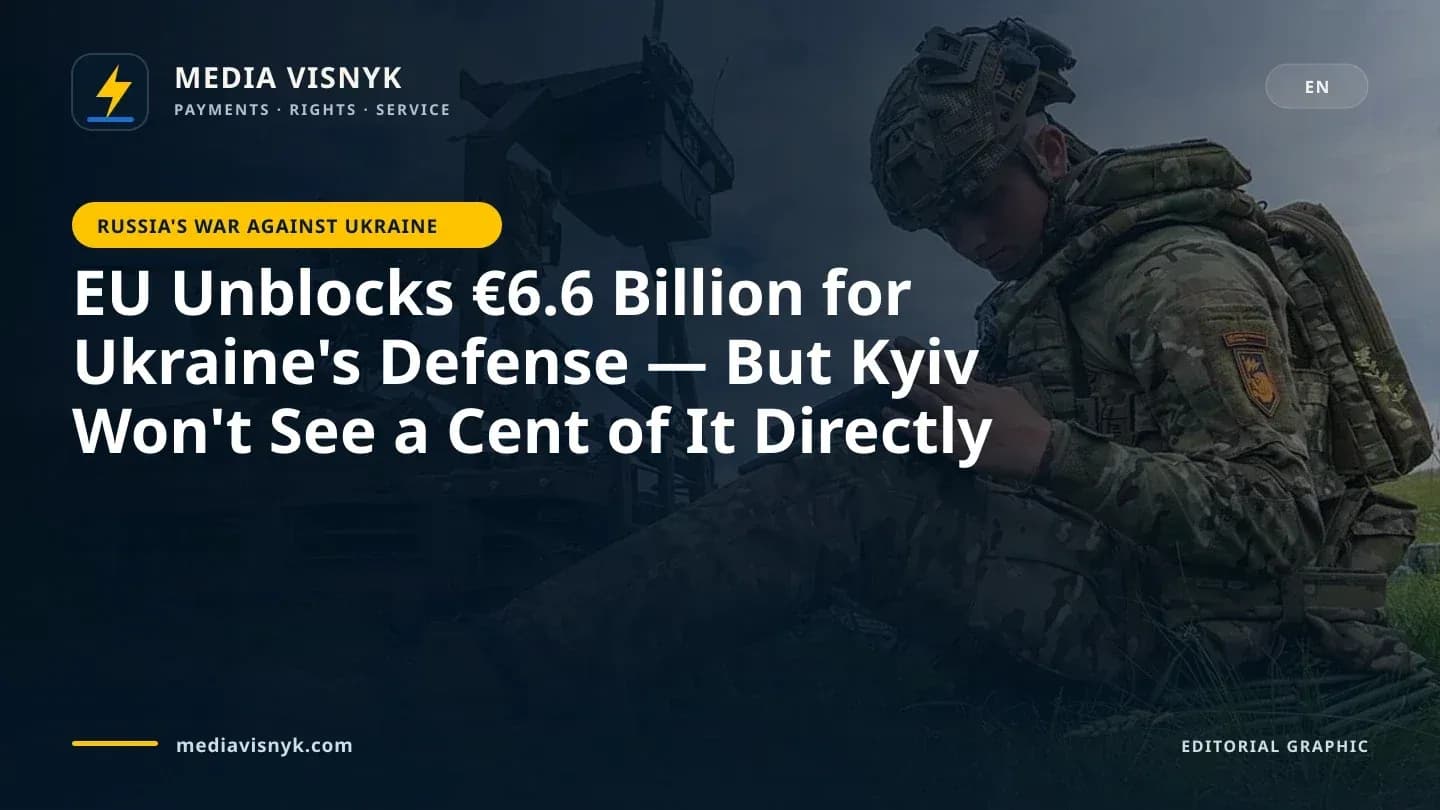
EU Unblocks €6.6 Billion for Ukraine's Defense — But Kyiv Won't See a Cent of It Directly
EU states agreed on the conditions to release €6.6 billion from the European Peace Facility after Hungary's veto. But the fund reimburses EU capitals, not Kyiv — and Ukraine still faces a $27 billion defense gap with winter drone orders due in October–November.
 1 / 4
1 / 4On paper, it looks like a breakthrough. After two and a half years of blockage, the EU agreed to release €6.6 billion tied to military aid for Ukraine. The bloc's foreign policy chief, Kaja Kallas, called it "good news for Ukraine and bad news for Russia." European Commission President Ursula von der Leyen went further: "great news."
But before celebrating, it's worth understanding what was actually agreed — and who the money goes to.
Where the €6.6 billion actually goes
The European Peace Facility (EPF) is not an account that pays Kyiv. It is a reimbursement mechanism: it returns money to EU member states for roughly 40% of the value of the weapons they have shipped to Ukraine from their own stockpiles. When Germany sends tanks, the fund compensates Berlin.
According to Kallas, the agreed package breaks down as follows: €900 million for the EU's military assistance mission to Ukraine (EUMAM, which trains Ukrainian soldiers), €1 billion for new joint procurement of equipment, and €4.7 billion in reimbursements to member states themselves.
And here is the catch. Kallas noted that some countries have already pledged to redirect their share of the reimbursements back into support for Ukraine. But "some" is not "all," and no mandatory percentage was set. That means of the €6.6 billion, at most €1.9 billion is guaranteed to end up as weapons for Ukraine. The rest depends on decisions by individual capitals.
The European Commission says the funds will help procure air defense systems, missiles, ammunition and radars. True. But this is not €6.6 billion arriving in Ukraine's budget — it is money that must flow through several separate government decisions before it becomes a missile battery.
Why the money was stuck for two years
The EPF operates by unanimity. That means a single country can block everything.
Hungary under Viktor Orbán did exactly that in the spring of 2023 — and held the line for over two years. In the meantime, the fund accumulated more than €40 billion in unpaid reimbursements to donor states. Germany and the Netherlands were hit hardest: they kept shipping weapons while getting nothing back.
The turning point came in early June 2026, when Hungary's new government under Prime Minister Péter Magyar reversed Orbán's veto. Magyar was quick to add, however, that Hungary will still provide no direct military aid to Ukraine. It simply stopped blocking everyone else's payments.
So the September deal is not the EU suddenly changing its mind. It is the endgame of a process that started in June. All summer, member states argued over the key question: should reimbursements go back into national budgets, or be channeled into new weapons for Ukraine?
Now, the other number: $27 billion
On the very same day, Zelensky told journalists about the hole in Ukraine's defense budget: $27 billion. And he explained why this is not abstract accounting.
"About a third of this money, maybe even a bit more — for January, February and March — is for drones," he said. The logic is simple: for drones to fly in winter, orders must be placed and paid for in October and November. Manufacturing takes time. Miss the autumn window, and January–February bring "serious challenges."
Translated from diplomatic language: if the orders aren't paid this fall, Ukraine could face empty drone warehouses just as Russia launches its customary winter campaign against the power grid.
For scale: Ukraine plans to spend around $97.6 billion on defense and security in 2026. A $27 billion shortfall is more than a quarter of that entire budget.
What Kyiv is doing about it
Zelensky says he raised the issue with von der Leyen and the IMF. The main hope is not the peace facility but a €90 billion EU loan agreed in December 2025 to cover 2026–2027. Kyiv is asking the European Commission to accelerate the second tranche — that, says Zelensky, is what would fund January–February drone and missile orders.
There is a catch here too. According to Reuters, only about half of the €90 billion is scheduled to arrive in 2026; the rest comes in 2027. The loan's timetable and the war's timetable do not currently match.
What we still don't know
An honest list. First, on September 25 the EU agreed on the conditions for releasing the funds — not the payment itself. When the money actually moves has not been confirmed. Second, no one knows what share of the €4.7 billion in reimbursements will really be redirected to Ukraine. Third, the fate of the remaining €34 billion of EPF debt remains unresolved — that will be a separate fight.
And the key point: no official document states that the €6.6 billion covers part of the $27 billion gap. The fund pays EU capitals, not Kyiv. The connection between the two figures is indirect at best.
So the real test is not Kallas's September statement. It is the November invoices. If Ukraine's drone orders are paid in October–November, the winter will be easier. If not, the EU will spend December once again debating who blocked what, and why.
Only this time the accounting will be done in drones over Ukrainian cities, not billions in press releases.
Primary sources
Documents and statements this story is based on.
- Reuters — EU agrees to release €6.6 billion linked to Ukraine military aid
- Kaja Kallas, official statement (X)
- Ursula von der Leyen (X)
- Euronews — EU countries agree to release long-stalled €6.6 billion in military aid for Ukraine
- Ukrinform — Zelensky warns of drone shortages in winter due to $27B budget deficit
- Ukrinform — Hungary lifts block on Ukraine arms reimbursements (via Politico)
- UNITED24 Media — Hungary drops Ukraine EU veto
- Reuters — EU loan throws Ukraine lifeline, more help needed
- Kyiv Post — 2027 budget
- European Parliament briefing — European Peace Facility
- Hromadske (ru) — Zelensky on the defense budget deficit