
Zelensky warns US not to play Putin's game: Operation Vivaldi frees up to 140 sq km, but Kyiv fears backroom oil deal
Zelensky told Reuters that playing with Russian compromises is a waste of time, revealed Operation Vivaldi has freed 125–140 sq km, and put Russian losses at 42,000 per month. Meanwhile, NYT reports US-Russia talks now include a multi-billion dollar Lukoil oil deal involving Kushner and Witkoff.
 1 / 4
1 / 4President Volodymyr Zelensky did something on Thursday that leaders dependent on foreign aid rarely do: he openly told his benefactor they might be making a mistake.
"I think we will waste time if we play with Russian compromises," Zelensky said in an exclusive interview with Reuters. Putin, he warned, will keep raising demands the moment he sees Washington's need for a "win" before the US midterm elections.
The warning wasn't just diplomatic protocol. It was a cry of alarm.
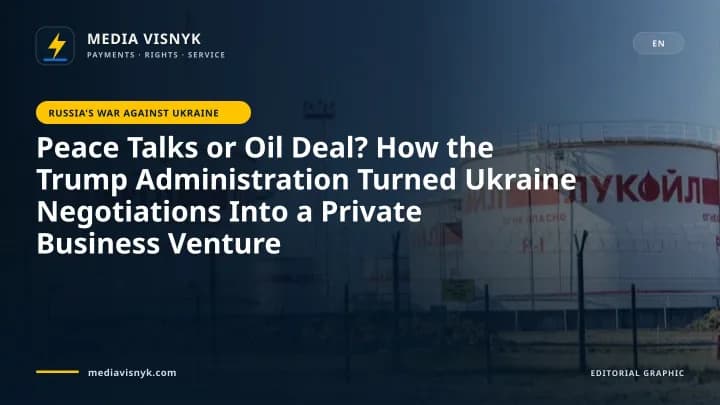
Because while Zelensky was detailing the successes of Ukraine's Operation Vivaldi, The New York Times published an investigation revealing that US-Russia talks on ending the war have expanded to include a multi-billion dollar oil deal involving Lukoil assets. According to the report, Putin himself raised the sale of Russian energy assets during discussions with Trump's special envoys — Jared Kushner and Steve Witkoff.
In other words, while Ukrainian troops are liberating villages in Donbas, Washington is discussing how much to pay the Kremlin for peace.
Operation Vivaldi: what the numbers show
Zelensky for the first time gave specific figures for the offensive that has been underway for several months. "Vivaldi is a very successful operation. It is not yet finished. As of today, approximately 125–140 square kilometers have been liberated," he said.
Earlier, commander of the 3rd Army Corps Andriy Biletsky reported that the third phase alone (completed September 28) added 51 km² — liberating Nove, Ridkodub, Katerynivka, and restoring control over Karpivka and Novomykhailivka. In total, the corps has reclaimed 176 km² since the start of offensive operations.
Biletsky revealed an intriguing tactical detail: Soviet BTR-60 armored personnel carriers were converted into robotic kamikaze vehicles to breach defenses. The Russians were convinced the main strike would come at Shandryholove–Zelena Dolyna, wasting reserves in counterattacks while the real blow fell on Nove.
Russian losses in the third phase: approximately 2,000 men, over 250 prisoners.
42,000 per month — and rising
Zelensky also updated Russian casualty figures. Earlier this year, losses stood at 30,000–32,000 per month (21,000–22,000 killed, the rest severely wounded). Now, he said, the figure has climbed to 42,000.
The Institute for the Study of War confirms the trend: September 2026 was a record month, with 46,320 Russian casualties according to the Ukrainian General Staff. Russia is losing men faster than it can train replacements — yet continues to press attacks.
Zelensky did not disclose Ukrainian losses, saying only that they are "several times smaller." This is standard wartime practice, but the absence of numbers leaves room for speculation.
The real battle is not on the front line
The most striking part of the interview was not about the war itself — but about the politics surrounding it.
Zelensky said he trusts the US desire to end the war. But he added: "It is difficult to stop someone so big who does not want to stop."
That was about Putin. But not only.
The Ukrainian president went on to warn that Putin will do everything to "pressure the Iranians and bring the situation to the point where negotiations become impossible." In other words, the Kremlin has no intention of making real compromises — it is simply stalling, betting on Western fatigue.
And here lies the core problem: according to the NYT, Washington is already engaged in talks that go far beyond Ukraine. An oil deal with Russia is not about peace in Ukraine. It is about business. If Trump gets a "win" in the form of a deal with Putin, the price of that win could be Ukrainian territory.
Zelensky understands this. That is why he said: "America is a hundred times stronger than Russia — and should not forget it."
What comes next
On October 4, Zelensky announced that Ukraine has agreed to a trilateral technical meeting in the UAE. "The ball is now in Russia's court," he said. But no date has been set.
The same day, he revealed that Ukraine still has a $4 billion budget deficit. Germany announced a new €1.3 billion aid package — a drop in the ocean.
While Kyiv counts money, Moscow and Washington appear to be counting barrels.
The central question left by Zelensky's interview: will the White House listen? Will Operation Vivaldi become a bargaining chip at the negotiating table — or just a footnote in a story where superpowers carve up spheres of influence?
The answer will come in the coming weeks. And it may determine whether Ukraine has any chance of ending this war on its own terms.
Primary sources
Documents and statements this story is based on.
- Reuters — Exclusive: Zelensky warns US against compromises with Putin
- Ukrinform — Zelensky: Ukrainian forces have liberated 125-140 sq km in Operation Vivaldi
- Ukrinform — Biletsky: 3rd Army Corps liberates Nove, Ridkodub and Katerynivka in Operation "Vivaldi"
- Eurointegration.com.ua — Zelensky: in talks with Russia, America must not forget it is 100 times stronger
- Kyiv Post — Operation Vivaldi Liberates up to 140 Sq Km in Donbas
- Institute for the Study of War — Russian Offensive Campaign Assessment, October 1, 2026
- The New York Times — U.S.-Russia Talks on Ukraine Now Involve an Oil Deal Tied to Trump Allies
- Reuters — US-Russia talks on Ukraine involve multi-billion dollar oil deal, NYT reports
- Reuters — Exclusive: Ukraine will hit Russian refineries in response to Moscow's 'new doctrine' of airstrikes
- Kyiv Post — Long-Range FP-9 Missile Ready This Fall, Zelensky Says
Peace Talks or Oil Deal? How the Trump Administration Turned Ukraine Negotiations Into a Private Business Venture
Putin's Envoy Held “Constructive” Talks in Washington. Over the Same 24 Hours, Russian Drones Were Killing People in Kyiv
'Choke Russia's Revenues': Zelenskyy's UN Plea Lands as Drones Hit Kyiv — and an 'Energy Truce' With No Referee Takes Shape