Ukraine’s Reservation System Under Fire: 16 Think Tanks Demand Moratorium, Business Warns of Defense Industry Collapse
Sixteen Ukrainian analytical centers and business associations demand an immediate moratorium on the government’s new reservation rules, warning that quota cuts could hit defense plants, energy companies, and municipal heating providers — including a frontline Mykolaiv utility that may lose 120 workers.
 1 / 4
1 / 4The government says it wants to clean up abuse in the reservation system—a mechanism that allows critical enterprises to keep key employees from being drafted. Prime Minister Serhiy Koretskyi points to “Ukrenergo,” the national power grid operator, where, according to him, only 20 out of 100 reserved employees actually do work for the company. The rest, he claims, are just “present.”
But the proposed fix, adopted by the Cabinet on October 13 in a closed session, is drawing sharp criticism.
What the government is proposing
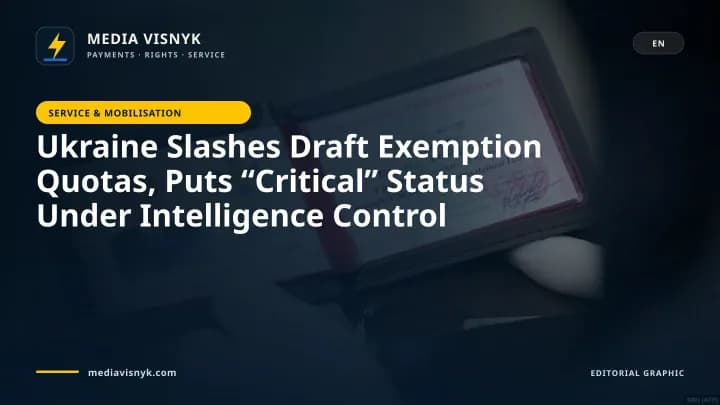
The new resolution cuts reservation quotas:
- For defense industry and energy enterprises: from 100% to 85%.
- For municipal utilities (heat, water, waste): from 75% to 60%.
It also creates a Coordination Center for Reservation—an advisory body under the Cabinet with up to 17 representatives from security agencies (Defense Ministry, Interior Ministry, General Staff, SBU, intelligence). The review period for criticality applications is extended from 10 to 17 working days.
The think tanks’ response
On October 16, sixteen analytical centers—including the Center for Economic Strategy, CASE Ukraine, and the Institute for Economic Research and Policy Consulting—published a joint appeal to the President, Cabinet, Parliament, and the National Agency on Corruption Prevention. Their demand: an immediate moratorium on revising critical enterprise statuses and a 90-day transition period for public consultations.
The appeal warns that the new rules will hit the defense industry, energy sector, and municipal infrastructure hard. The Federation of Employers of Ukraine (CEO Ruslan Illichov) says the actual impact may be even worse than the official numbers suggest, because changes in calculation methods could further reduce available limits.
A concrete example: Mykolaivoblteploenergo
The municipal heating company in frontline Mykolaiv may lose 120 employees if its quota drops to 60%. Director Mykola Lohvinov is pleading with the government not to cut, but to increase the quota to 100%. “Every worker is essential to keep the heat on in a city under constant threat,” he says.
What about defense factories?
A 15% cut in reservation quotas for defense enterprises means that one in seven critical specialists could be mobilized. Instead of producing drones, ammunition, or repairing military equipment, they would end up in the trenches. Business associations predict a collapse of defense production. While this is still a forecast, the risk is tangible.
Where is the logic?
Analysts point out that the government promised to fix the reservation system back in October 2024. Two years later, instead of targeted measures against abuse, it is applying a “carpet bombing” approach that threatens legitimate enterprises. One controversial proposal—to exclude employees already eligible for deferment under Article 23 of the Mobilization Law from the quota base—was removed during revision. But the core cuts remain.
As of October 18, the final text of the resolution has not been officially published. The Cabinet has not responded to the think tanks’ appeal. The business community is waiting. So are the people of Mykolaiv, who may face a winter without heat.
The question for the government is simple: do you really want to fight schemes, or just reduce the number of reserved employees regardless of consequences? If it’s the latter, the price will be paid by those who keep the country running—and by the people who depend on them.
Primary sources
Documents and statements this story is based on.
- UNN — Cabinet of Ministers urged to introduce a moratorium until consultations on reservations are completed
- Apostrophe — New reservation rules: analytical centers called on the authorities to impose a moratorium on revising the status of critically important enterprises
- Informator — New reservation rules: “carpet bombing” instead of fighting schemes
- 7eminar.ua — Reservation under threat: new rules from October 18
- Center for Economic Strategy — Appeal of analytical centers regarding reservation changes
- RBC-Ukraine — “There is no betrayal”: Koretskyi explained what to expect from reservations
- News.PN (Mykolaiv) — Mykolaivoblteploenergo may lose 120 employees
- Interfax-Ukraine — Analytical centers urged the government not to change reservation rules without a transition period
- Glavcom — Government plans to limit reservations: Koretskyi explained the reason and gave an example with Ukrenergo
- Financial Club — Analytical centers urged the government not to change reservation rules without a transition period