
A Shield for the Rich: How the Koretsky Government Is Preparing Class-Based Mobilization
The Ukrainian government is finalizing changes to military deferment rules. Fairness? No, just a price tag: if you have money, you're a “critical worker.” While some fight for a salary of 20,000 hryvnias, others pay and get a deferment. The state is legalizing class inequality in matters of life and death.
 1 / 4
The government led by Prime Minister Koretsky is preparing a real gift for those who can afford it. On October 20–21, a resolution is expected to be finalized that would overhaul the military deferment system. The core changes: abolishing 100% quota caps and introducing so-called “economic deferment” — essentially, the right to buy your way out of mobilization.
The state has finally found a fair principle: whoever pays is critical. Sounds cynical? Absolutely. Yet this is what is being presented as a solution.
While some are spending their third year in trenches for a salary of 20,000 hryvnias (about $540), others — sons of well-connected families, business owners, IT professionals — will simply pay and forget about their draft summons. And the state is not just allowing this; it is codifying it into law.
Economic deferment means your life is worth exactly as much as you have. More money — more chances to survive. Less money — welcome to the enlistment office.
Here’s the question: what about the constitutional duty to defend the homeland? Turns out, it can be replaced by a cash contribution. The state no longer needs your service — it needs your money.
Of course, no one says this openly. The official rhetoric is about “economic incentives,” “retaining skilled workers,” and “balancing the front and the rear.” But in practice, it works like this: if you can pay a few tens of thousands of hryvnias a month, you are a critical worker. If not, you are cannon fodder.
Significantly, Prime Minister Koretsky gave an interview to the BBC on October 19, effectively confirming these plans. He said, “we are looking for a fair mechanism.” Fair for whom? For those who can pay? Or for those who fight?
We are not against a functioning economy. But when the right not to fight is purchased with money, that is not economics. That is class-based mobilization. It means the poorer die so the richer can keep accumulating.
And the worst part: this is no accident. It is a deliberate policy. The government is consciously choosing a model where mobilization ceases to be a matter of conscience and duty and becomes a market service.
We ask: what will the families of the fallen say? What will veterans who lost their health say? Were they offered “economic deferment”? Or were they simply handed a draft notice?
Proponents of economic deferment will say: it’s voluntary, whoever wants to pay can. But where is the voluntariness when you have no choice? You either pay or go fight. And if you have no money, the choice is made for you.
This is not deferment. This is an indulgence. A medieval practice where sins were forgiven for money. Only now, the sin is unwillingness to fight, and the price is your life.
The Koretsky government is preparing a resolution that splits society into two classes: those who can afford safety and those who are forced to provide it. This is not about fairness. This is about money.
We will see if there are any votes in parliament to stop this. But for now, it seems “economic deferment” is the new course of power. A course toward class-based mobilization.
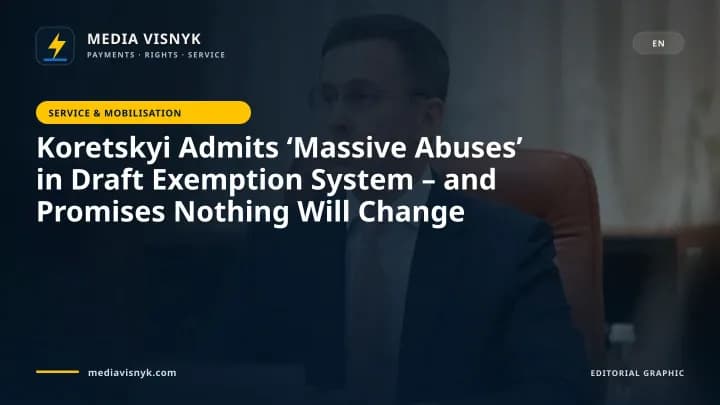
Koretskyi Admits ‘Massive Abuses’ in Draft Exemption System – and Promises Nothing Will Change
“Self-Defense” Against a Grandmother: How Ukraine’s Mobilization Machine Turned on Its Own People
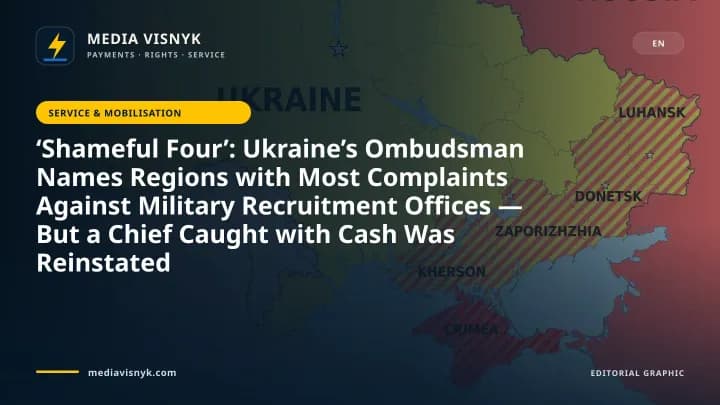
‘Shameful Four’: Ukraine’s Ombudsman Names Regions with Most Complaints Against Military Recruitment Offices — But a Chief Caught with Cash Was Reinstated
‘Shameful Four’: Ukraine’s Ombudsman Names Regions with Most Complaints Against Military Recruitment Offices — But a Chief Caught with Cash Was Reinstated