
Koretskyi Admits ‘Massive Abuses’ in Draft Exemption System – and Promises Nothing Will Change
Prime Minister Koretskyi publicly admitted “massive abuses” in Ukraine’s draft exemption system – and immediately promised there would be no radical changes. A column on why this is not helplessness but a deliberate policy of protecting “insiders,” from the 292 exempted priests to “critical” enterprises.
 1 / 4
The last days of October have been rich in stories about draft exemptions. On October 16, the prime minister made a statement that should have been the start of a crackdown. On October 18, news broke that 292 priests had received exemptions. On October 19, lawmaker Bezuhla called for audits. Three dots – and they form one simple picture: the system for “insiders” works flawlessly, and no one is going to touch it.
Let’s start with the key point – Koretskyi’s own words.
“Massive abuses.” That is how he described what is happening with draft exemptions. This should have been the moment of truth: a promise to restore order, punish the guilty, rewrite the rules. But no. The prime minister added a phrase that cancels any hope: “there will be no radical changes.” Especially for “critical” enterprises.
Do you feel the magic? First, admit the problem – that gives people hope. Then say nothing will change – that removes responsibility. The result: everyone is satisfied. Those who abuse the system are calm. Those who were outraged got a dose of “we see everything.” And the system keeps ticking like a clock.
Here is the interesting part. Koretskyi is not saying “we don’t know what to do.” He is saying “we know, but we won’t.” This is not helplessness. It is a deliberate choice. Because “radical changes” would mean touching those who cannot be touched. Big business, political allies, church structures – all those who have settled comfortably into the exemption system.
Remember the number: 292 priests. Not 29, not 92 – almost three hundred men in cassocks who received draft exemptions. Who verified that these parishes are truly “critical” to the economy? That each of these 292 priests performs functions without which the state would collapse? Rhetorical questions, of course.
But Koretskyi found an elegant way out: admit that abuses exist, but do not touch “critical” enterprises. And who decides which enterprise is critical? Right – the same people who are abusing the system. A closed loop that the government has no intention of breaking, because it is comfortable inside.
The irony is that Koretskyi has effectively legitimized the abuses. He said: “Yes, they exist. And yes, we will do nothing about them.” It is like a doctor diagnosing a disease and then saying: “But we won’t treat it, because the patient is important.” Except the patient here is not a person – it is a system that allows “insiders” to avoid mobilization.
Bezuhla, who called for audits on October 19, looks almost naive in this story. She is demanding what Koretskyi has already promised not to do. And that perfectly illustrates the state of Ukrainian politics: some talk about the problem, others talk about the impossibility of solving it, while the system stands like a rock.
What happens next? Nothing. Koretskyi admitted, promised not to change, and the government’s workday is over. Tomorrow there will be a new statement, a new admission, a new promise to do nothing. And the 292 priests, big business, and “critical” enterprises will continue to sleep soundly. Because in this country, admitting a problem is already considered solving it.
Only one question remains unanswered: how many more such “admissions” can those who are actually fighting – and those waiting for their turn at the enlistment office – endure?
“Self-Defense” Against a Grandmother: How Ukraine’s Mobilization Machine Turned on Its Own People
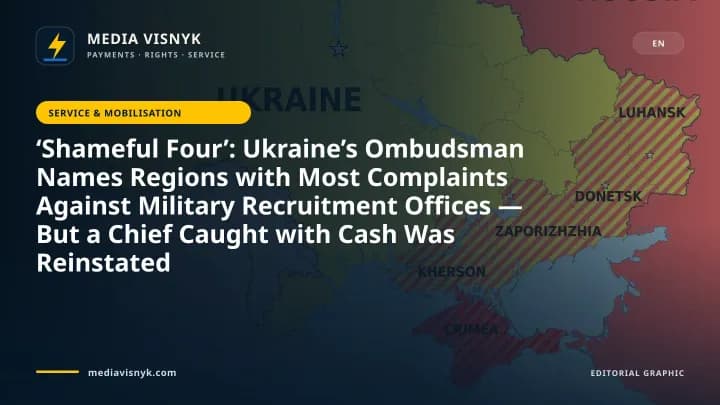
‘Shameful Four’: Ukraine’s Ombudsman Names Regions with Most Complaints Against Military Recruitment Offices — But a Chief Caught with Cash Was Reinstated
Police as the New Draft Office: The Bill That Turns Every Man into a Potential Detainee
SBU Shuts Down Four Draft-Dodging Schemes. How Many Schemes Are Inside the TCCs?