
“Self-Defense” Against a Grandmother: How Ukraine’s Mobilization Machine Turned on Its Own People
A 73-year-old woman in Kharkiv left her home and ended up with a broken hip and collarbone. The man who pushed her is a 29-year-old TCC soldier who calls it “self-defense.” A court suspended him on October 15, but the measure of restraint is still pending — and the column argues this is not an isolated incident but a system in which mobilization has become a war against civilians, silently condoned by the state.
 1 / 4
1 / 4Kharkiv, mid-October. A 73-year-old woman steps outside — maybe to the store, maybe to see a doctor, maybe just for fresh air. Seconds later, she has a fractured hip and collarbone. The person who did this is a 29-year-old TCC soldier. And his explanation? “Self-defense.”
Let that sink in. Self-defense. Against whom? Against a woman twice his age, unarmed, showing no aggression — just someone unlucky enough to cross paths with a “mobilization measure.” Imagine: a grown man in uniform, trained, carrying a service weapon, feels threatened by a pensioner with a walker (or without one) — and his first instinct is to shove her. And that’s called “self-defense.”
Of course, the TCC has an official version. It’s the usual “working” story: the woman allegedly resisted, interfered with the mission, behaved aggressively. But even if the grandmother argued — where is the line where a 29-year-old soldier stops being a state representative and becomes a street thug? And why is that line so easily erased?
To its credit, the court acted quickly — on October 15 it suspended the serviceman. Quick is good. But the actual preventive measure has yet to be chosen. And here’s the second sarcastic punch: while the court deliberates, while the TCC talks about “self-defense,” the woman lies in a hospital with fractures. She probably doesn’t care about legal nuances. She cares whether she’ll ever walk again.
But this isn’t about one case. Kharkiv is just the tip of the iceberg. Across the country, recruitment teams operate as if they were in occupied territory, not in Ukraine. People are grabbed on the streets, cars are blocked, men are pulled out of stores. And every time an incident occurs, the same mantra is repeated: “he wasn’t following orders,” “these are isolated cases,” “the perpetrators will be punished.” But punishment — if it ever comes — looks like a suspension pending investigation. And then? Then, most likely, nothing.
The third ironic contrast: Ukraine’s army fights Russian drones, missiles, artillery. That’s a real war where people die. But on the home front, the same army (or rather its mobilization arm) finds itself powerless against… pensioners. Seriously? You can’t stop a Shahed drone, but you can “defend yourself” against a grandmother? This isn’t just absurd — it’s a sign that the system has lost touch with reality.
And the state is silent. No statement from the President’s Office, no order from the General Staff, no public condemnation. At most, local police opened a case. But until the top leadership says out loud, “This is not acceptable,” the TCC will keep acting like occupation troops. Because impunity is the best fertilizer for arbitrariness.
What happens next? The court will choose a preventive measure. Maybe even a real one. But will that change the system? Will Kharkiv’s (and other) TCCs stop assaulting people? Will the feeling return that the state is a protector, not an enemy? For now, the answer is obvious: no. Because when “mobilization measures” become synonymous with attacking the unarmed, and “self-defense” becomes an excuse for crippling people, it means we’ve lost — not at the front, but at home.
And that’s the worst defeat of all.
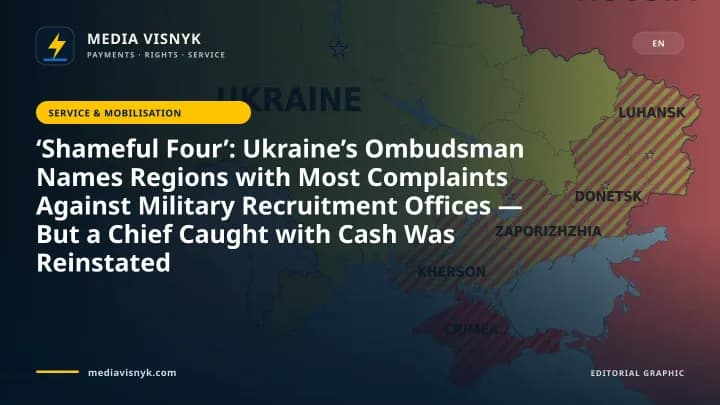
‘Shameful Four’: Ukraine’s Ombudsman Names Regions with Most Complaints Against Military Recruitment Offices — But a Chief Caught with Cash Was Reinstated
‘Shameful Four’: Ukraine’s Ombudsman Names Regions with Most Complaints Against Military Recruitment Offices — But a Chief Caught with Cash Was Reinstated

Police as the New Draft Office: The Bill That Turns Every Man into a Potential Detainee
55+ in the Trenches: Why the State Won’t Let Grandpas Go Home