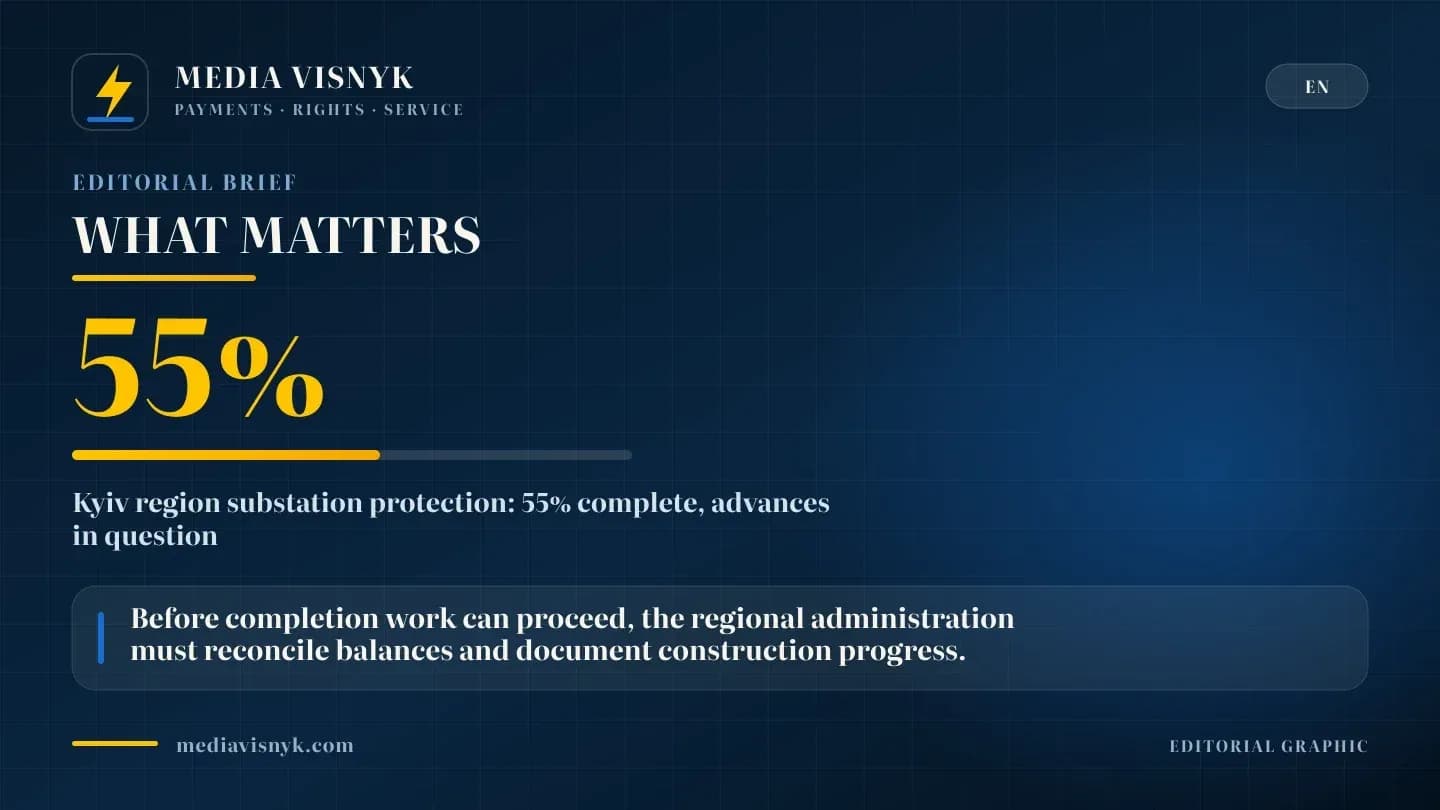
Kyiv region substation protection: 55% complete, advances in question
Before completion work can proceed, the regional administration must reconcile balances and document construction progress. How much of the advance payments is backed by completed work remains an open question.
Protection works at substations in Kyiv region remained unfinished going into November: the regional military administration put average construction progress at 55% as of November 11, 2026. Meanwhile, Restoration Agency head Ivan Fedorov said completing the troubled projects required a documented handover. At the time of his interview, no handover certificate existed.

The handover must distinguish not only unfinished structures but also financial responsibilities. How much of the advance payments is backed by accepted work, how much remains unspent and whether contractors owe any refunds are questions that must be answered to assess what earlier payments delivered. A construction completion percentage cannot replace that reconciliation.
In its response to an information request, the Kyiv regional military administration confirmed that its regional development department had awarded direct construction contracts without open tenders or an electronic catalogue. The agreements were signed between April 8 and mid-June. The administration said it had considered public state registers, the companies’ construction experience and previous cooperation with them.

The administration explained that completion was initially planned for October–November, before it demanded that deadlines be brought forward to August–September. Yet the November 11 figure shows that construction as a whole remained unfinished beyond those dates. An average construction completion percentage does not mean every substation has an equivalent level of protection against a strike.
Fedorov set out the sequence: the regional administration must reconcile balances, complete records of the current state of construction and assemble a documentation package. Under the procedure he described, preparing that reconciliation therefore falls to the regional administration, whose department awarded the contracts. After accepting the projects, the agency plans to select new contractors. DTEK granting access to the sites is another condition for work to begin. “And then we will be responsible for it,” he said.
However, his explanation contains no financial reconciliation results: how much of the advances is already accounted for through certificates of completed work, and what balance should accompany the projects. Nor does it identify who would pursue repayment if the reconciliation establishes grounds for it. The agency’s responsibility for future completion cannot therefore be equated with responsibility for checking earlier payments. Uncertainty about the balances also leaves uncertainty about how much public money is needed to finish the protection works.
That is markedly different from the spring promise of a managed preparation for winter. On March 3, when regional resilience plans were approved, the government tasked regional authorities with protecting substations, pumping stations and other local facilities. Then-prime minister Yuliia Svyrydenko stressed the personal responsibility of city and regional leaders and the government for failing to complete preparations, or completing them late.
For residents, the issue is reliable electricity, not a different institution’s name on the paperwork. Damage to substations can require emergency load reductions: these outages are imposed on Ukrenergo’s instructions, and normal schedules do not apply. However, the construction completion figure alone cannot establish that these contracts caused specific outages.
The regional administration must explain not only the missed accelerated deadlines but also whether payments match work actually accepted. That requires a contract-by-contract reconciliation of advances, work backed by completion certificates and remaining funds. Those results should establish what is being handed to the agency for completion and what financial obligations remain between the previous contracting authority and its contractors.
Primary sources
Documents and statements this story is based on.