Business shelters: Kyiv’s map cannot answer the capacity question
A spatial analysis found 8,700 Kyiv businesses without a shelter within 300 metres. Even a nearby address does not guarantee space: the register used lacked capacity figures.
Ahead of 4 December 2026, the requirement to provide shelters for businesses runs up against more than distance. A spatial comparison of roughly 59,000 Kyiv business premises with 3,100 publicly accessible shelters identified 8,700 premises without a shelter within 300 metres. The analysis cannot establish whether there is enough space for the rest: the city register used contained no capacity figures.
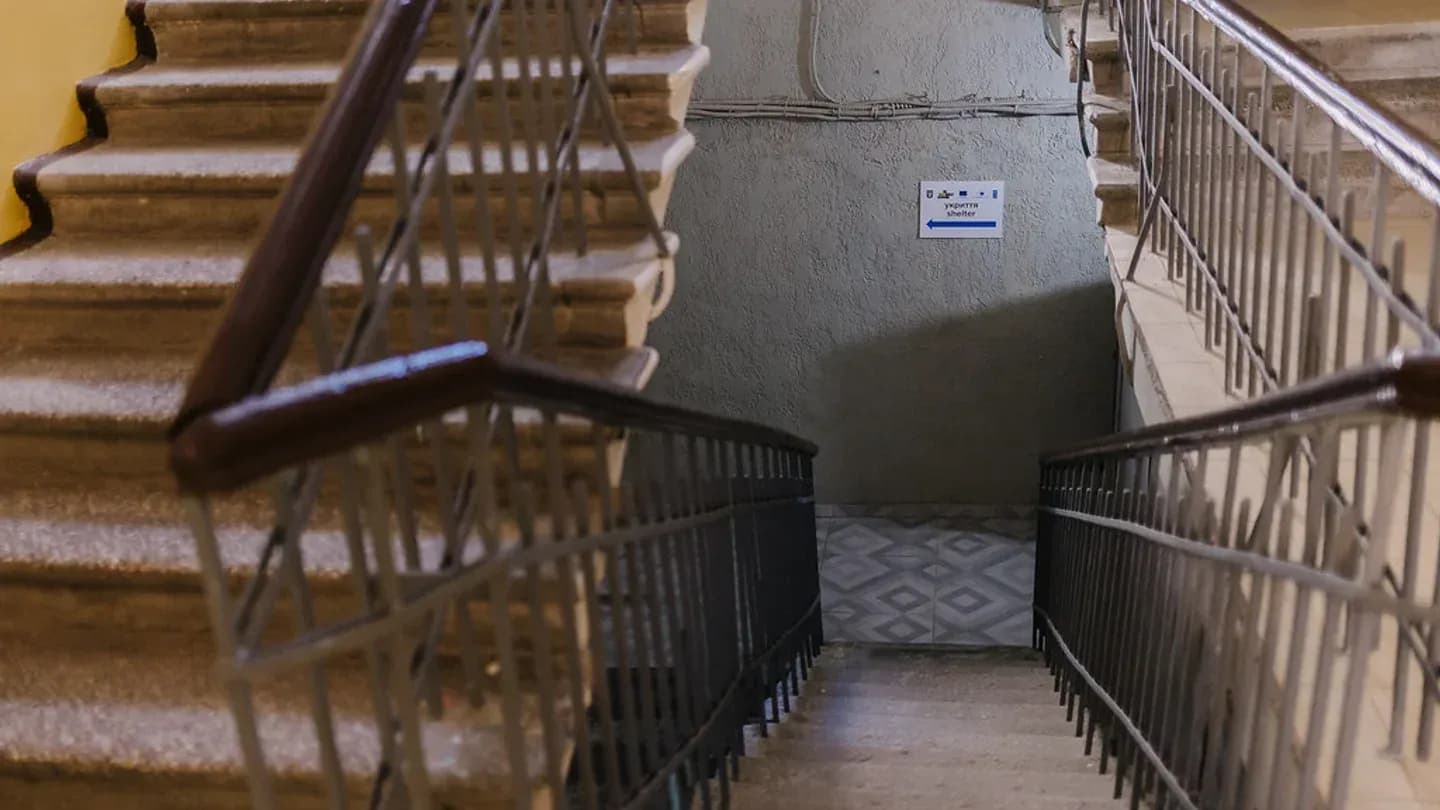
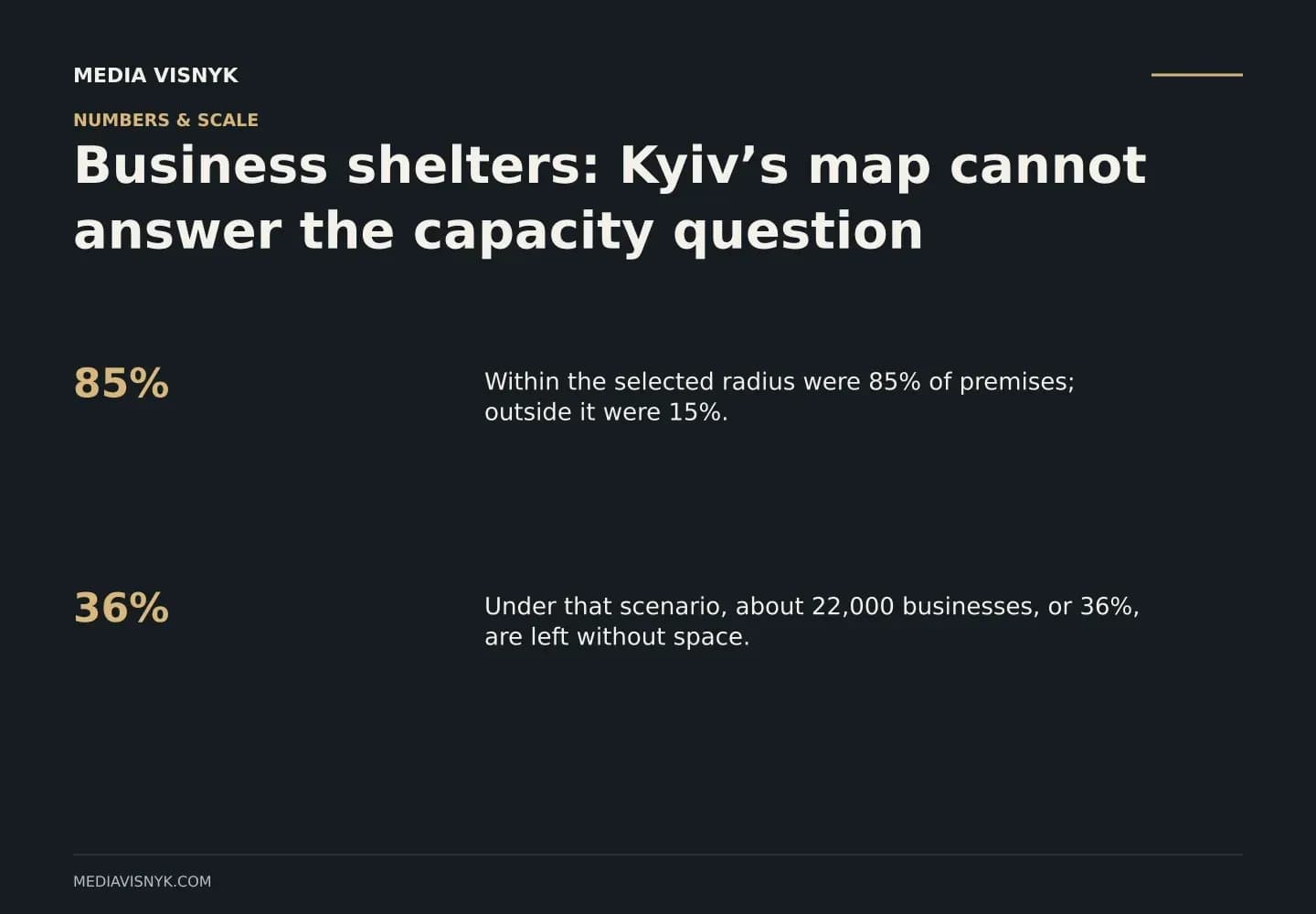
The comparison used coordinates for cafés, shops, beauty salons, vehicle repair shops and offices from an open mapping database, alongside shelters in the city register accessible to the general public, excluding school shelters and those under repair. The nearest shelter was identified for each business. Within the selected radius were 85% of premises; outside it were 15%. This measures distance in a particular sample, not the established share of businesses breaking the rules: the applicable standard depends on the type of development and site.
The December date relates to the three-month transition period in Resolution No. 1092 of 4 September. Its provision on operating during a yellow threat level requires a protective structure, a temporary or permanent shelter, a dual-purpose structure or a safe space. Businesses operating without a shelter with their workforce's agreement face a time limit: no longer than three months from the resolution taking effect.

Businesses cannot automatically assume this period will be extended until spring. On 16 November, MP Yaroslav Zhelezniak described an Economy Ministry draft: an extension until 4 April 2027 for those documenting by 4 December that shelter preparation has begun, and until 4 June for those building under a construction design. Adoption of these particular amendments has not been confirmed as of 22 November. A description of a draft does not entitle a business to an extension.
In a letter to the Cabinet dated 28 September, the Interior Ministry proposes calculating the need for shelter spaces by the maximum number of people present at once, rather than the number of businesses nearby. The letter addresses criteria for premises with large numbers of people: 100 or more at the site, or at least one separate room capable of holding 50 or more simultaneously. These criteria should not be applied without explanation to every small café. Nor does this mean small businesses are exempt from the resolution's requirements for operating during a yellow alert.
For such large-occupancy sites, the ministry proposes counting employees, visitors and others present at peak times, including weekends and holidays. Where actual attendance statistics are unavailable, calculations should use design capacity, throughput or other justified indicators. The needs of people with limited mobility and children should be considered separately.
The same letter cites the walking-access radius in the procedure approved by Resolution No. 138: no more than 300 metres for multi-storey and high-rise development and businesses assigned to the relevant civil-protection categories; 500 metres for medium- and low-rise development. A uniform 300-metre circle on a map therefore cannot replace checking the conditions at a particular site.
To model limited space, the Kyiv analysis applied an assumption: each shelter can accommodate no more than ten notional businesses. Under that scenario, about 22,000 businesses, or 36%, are left without space. This is not a measured shortage: ten businesses is an assumed limit in the model, not the established capacity of basements or car parks. A small hair salon and a large retail floor need different numbers of spaces.
The gap in the register used has a practical consequence: coordinates alone cannot tell a business owner whether the nearest shelter can accommodate their employees and visitors alongside other people. City authorities are accountable for verifiable information on capacity and access conditions, not just addresses on a map. Without shelter capacity and peak occupancy figures for businesses, a scenario calculation cannot become a reliable assessment of the need for spaces.
For business owners, the practical conclusion is to check not only the nearest address but also access, capacity and the route for employees and visitors. For the government and city authorities, accountability comes down to a specific question: how will they ensure verifiable capacity calculations and clear operating conditions before the transition period ends? Moving a deadline does not itself add a single shelter space.
Primary sources
Documents and statements this story is based on.