
Ukraine's Police Trust Crisis Has Another Side: Two Officers Killed While Documenting a Russian Strike
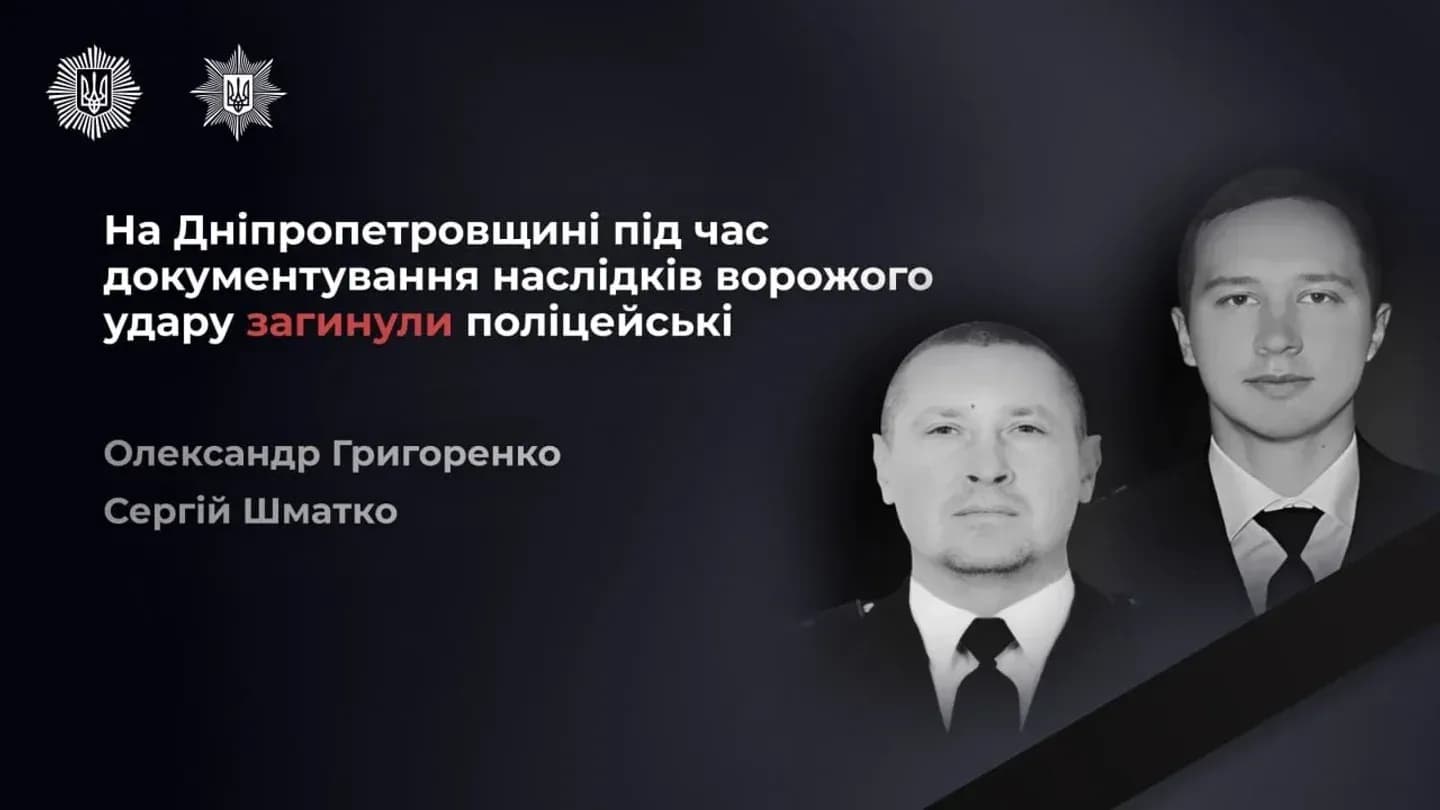
Two Ukrainian police officers were killed in a repeat drone strike while documenting a Russian attack in Dnipropetrovsk region. The same uniform is tied to mobilization duties — and to a growing trust crisis.
 1 / 4
1 / 4The deaths expose a contradiction inside Ukraine that is easy to miss from abroad.
Ukraine's National Police is simultaneously a conventional law-enforcement agency, a wartime emergency service and — increasingly — a participant in the country's mobilization system.
Those roles do not look the same to the public.
Hryhorenko was 40 and had served in the police for almost 11 years, eventually becoming a patrol response sector chief in the Pavlohrad district.
Shmatko was 27. He had worked as an investigator and criminal investigator before serving as an investigator at a local police department from 2025.
Neither man was conducting a mobilization operation when he was killed.
They were documenting the aftermath of a Russian attack.
Yet the same police uniform has become increasingly associated inside Ukraine with another controversial task: supporting Territorial Recruitment and Social Support Centres, commonly known by the Ukrainian abbreviation TCC, during mobilization-related activities.
Ukraine's own police chief has acknowledged the reputational damage.
In an April 2026 interview published by the National Police, chief Ivan Vyhivskyi said police participation in mobilization had generated enormous public negativity. He said some Ukrainians had begun hesitating before calling the police because they feared officers might take them or their relatives away in connection with mobilization. He also described police ratings as falling critically and said public trust built since 2015 was being destroyed.
Vyhivskyi also acknowledged that police investigate cases involving illicit benefits received by TCC personnel.
That does not make every recruitment officer corrupt, and it certainly does not make every police officer responsible for abuses committed elsewhere in the system.
That distinction matters.
Ukraine has effectively placed very different state functions behind the same uniform: crime prevention, frontline evacuation, investigation of war crimes, emergency response, document checks connected with mobilization and, in legally specified circumstances, administrative detention and transportation to recruitment centres.
Ukrainian law does provide the police with some of those mobilization-related powers. Police may participate in notification measures alongside TCC representatives and, under statutory conditions, administratively detain and deliver people suspected of specified mobilization-related administrative offences.
But those powers are not unlimited.
Article 8 of Ukraine's Law on the National Police requires officers to act only under the Constitution and legislation and prohibits them from carrying out criminal or manifestly unlawful orders.
That makes blanket claims that all police involvement in mobilization is inherently unconstitutional inaccurate.
Individual actions can be unlawful. Excessive force can be unlawful. A specific order can be unlawful.
Those cases need evidence and individual accountability.
The September 3 deaths raise a different accountability question: how police personnel are protected when they enter areas hit by Russian weapons.
Ukraine's Interior Ministry already has specific rules for the danger of repeat attacks.
Amendments introduced in 2024 require police duty officers to exchange information with the Ukrainian Air Force, the State Emergency Service and other authorities regarding the threat of additional artillery, missile, air or drone attacks. When a new threat is reported, officers at the scene are to be warned immediately so personnel and vehicles can move to safety.
The publicly available instruction reviewed for this article does not establish a universal rule requiring police to wait a fixed number of minutes after every strike.
The system instead depends on threat information, communications, the availability of shelter and decisions made at the scene and by duty officers.
That leaves several unanswered questions about the Bohdanivka incident.
Was the investigative team warned about another incoming drone?
Was information about the threat available before the second strike?
What shelter or withdrawal route had been identified?
Were additional detection or warning systems available?
The National Police has not publicly answered those questions in its initial statements. A later police report said the incident caused a fire and damaged a police vehicle.
There is therefore no public evidence at this stage that police commanders knowingly sent the officers into a second strike.
But there is also not enough public information to determine whether all applicable safety procedures worked as intended.
The wider issue has international relevance.
The UN Human Rights Monitoring Mission in Ukraine has previously documented so-called “double-tap” attacks — successive strikes on the same site after emergency workers arrive. The UN has warned that a second attack during a period when first responders can foreseeably be present can raise serious international humanitarian law concerns. If an attack is deliberately intended to kill first responders or other civilians, it may constitute a war crime. That legal conclusion cannot yet be automatically applied to the September 3 incident without evidence of targeting and intent.
For Ukraine, however, the domestic lesson is already visible.
When the state assigns one institution radically different and politically explosive duties, public anger stops distinguishing between the officer accused of abuse and the officer documenting a missile strike.
Hryhorenko and Shmatko paid the ultimate price for a very different kind of police work.
A government cannot demand public trust only through statements after officers die.
It also has to decide what it wants the police uniform to mean.
Primary sources
Documents and statements this story is based on.
- National Police of Ukraine — statement on the deaths of Oleksandr Hryhorenko and Serhii Shmatko
- Ministry of Internal Affairs of Ukraine — statement on the deaths of two police officers
- National Police of Ukraine — report on attacks in Dnipropetrovsk region
- Interior Ministry Instruction No. 357 on the organization of police response
- Interior Ministry Order No. 297 of 08.05.2024
- Law of Ukraine "On the National Police" — powers in interaction with territorial recruitment centres
- Law of Ukraine "On the National Police" — powers in interaction with territorial recruitment centres
- Law of Ukraine "On Mobilization Preparation and Mobilization"
- National Police of Ukraine — interview with Ivan Vyhivskyi of 23.04.2026
- Suspilne Dnipro
- UN Human Rights Monitoring Mission in Ukraine — report on first responders and double-tap attacks