
Ukraine receives €4.36 billion from EU for budget and defence
The government reported funding under the Ukraine Support Loan: €3.7 billion in macro-financial assistance and €660 million in defence financing.
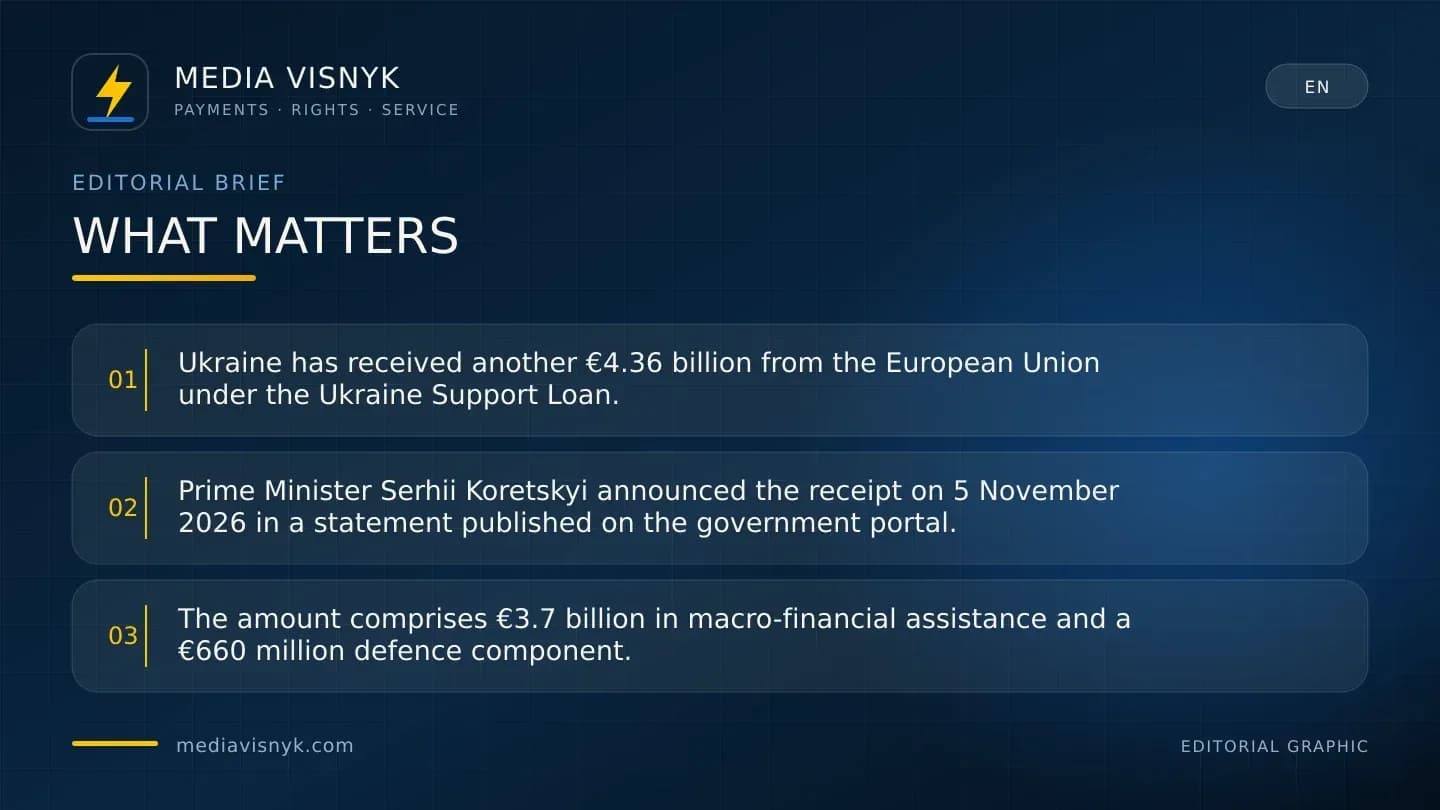
Ukraine has received another €4.36 billion from the European Union under the Ukraine Support Loan. Prime Minister Serhii Koretskyi announced the receipt on 5 November 2026 in a statement published on the government portal. The amount comprises €3.7 billion in macro-financial assistance and a €660 million defence component.
According to the prime minister, the funds will support priority budget expenditure and the most urgent needs of the Defence Forces. The government continues to work with European partners to ensure that the remaining planned financing arrives on time and in full.
In a separate statement on the government portal that evening, the Ministry of Finance specified that €3.7 billion had already reached the state budget. This is the macro-financial portion of the announced €4.36 billion, not an additional tranche on top of that sum. The money is intended for priority expenditure, the stable operation of state institutions and macro-financial stability.
Including the new payment, Ukraine has received €7.7 billion under the budget component of the Ukraine Support Loan, of which €6.9 billion is macro-financial assistance, the ministry said. The country received its first macro-financial tranche of €3.2 billion in June 2026.
The Ukraine Support Loan totals up to €90 billion for 2026–2027. According to the ministry, €30 billion is earmarked for economic and budget support and €60 billion for defence needs. For 2026, the programme provides for up to €45 billion: €16.7 billion for budget needs and €28.3 billion for defence capabilities.
Budget financing is channelled through EU macro-financial assistance and the Ukraine Facility, each providing for up to €8.35 billion in 2026. The ministry explains that macro-financial assistance is linked to implementing reforms agreed with the EU on public financial management, spending efficiency, domestic revenue mobilisation and further European integration.
Primary sources
Documents and statements this story is based on.