
7 Years for Torture in a Military Enlistment Office: Odesa Verdict, but the System Remains Unchanged
A court in Odesa has sentenced nine members of TCC notification groups for abducting, beating and robbing men on the street. Six received real prison terms of up to 7 years 1 month. Yet the 5,607 complaints against TCCs filed in just nine months of 2026 suggest the problem is systemic — and far from solved.
 1 / 4
1 / 4In April–May 2026, a coordinated group operated in Odesa: uniformed personnel and civilians who patrolled streets, grabbed men, forced them into cars, and drove them to a district TCC. They didn’t just “verify data” — they beat victims, humiliated them, threatened sexual violence, used tear gas. One victim lost consciousness. Another had 5,200 hryvnias taken from his wallet by one of the “notification officers.”
In June, the State Bureau of Investigation (SBI) uncovered the group. Nine people — both military and civilian — went to trial. All pleaded guilty and signed plea agreements with prosecutors. The court approved: six received real prison terms (the longest — 7 years 1 month), two got 2 years of restricted service with 10% pay deduction, one got 5 years probation with a 2-year supervision period. Four were banned from working in TCCs or participating in mobilization activities for three years.
This sounds like a victory for justice. The Prosecutor General’s Office, the SBI, and the specialized defense prosecutor’s office worked effectively — at least in this specific episode. But here’s the catch: the trial is still ongoing for two more suspects in the same case. The group was larger.
And then there’s the bigger picture.
Ukraine’s Ombudsman Dmytro Lubinets released figures: in the first nine months of 2026, his office received 5,607 complaints about possible illegal actions by TCCs. That’s almost as many as for the entire year of 2025. The leading regions are Dnipropetrovsk, Odesa, Lviv, and Zakarpattia. Odesa is on that list — the very region where these nine were convicted.
So the verdict is not an exception; it’s a symptom. The system that allows “notification officers” to act with near-impunity continues to function. Otherwise, where would 5,600 complaints in under a year come from?
Will this verdict change practice? Formally, yes — a precedent has been set. Realistically, unlikely — as long as TCCs remain structures with almost no oversight, where commanders are not held accountable for their subordinates. Four were banned from TCC work — but only for three years. What will other “notification officers” do tomorrow? The answer is known to the victims who are afraid to walk the streets in Odesa.
The core question is: how did people tasked with “notifying” about mobilization turn into a kidnapping gang? The answer is simple: unchecked power, lack of clear procedures, and a culture of impunity. Until these three components change, verdicts will remain isolated, and complaints will number in the thousands.
The Odesa story is not the end. It’s just one episode in a long-running series called “TCC: The Right to Violence?” And until the series is cancelled, the audience — that’s us — will keep fearing a knock on the door or a shout on the street.
Primary sources
Documents and statements this story is based on.
- TSN — “They abducted men, beat them and took their money: Odesa court delivers verdicts to members of TCC groups”
- Ukrinform — “Abduction and torture: nine members of TCC notification groups in Odesa receive verdicts”
- Office of the Prosecutor General (Facebook)
- State Bureau of Investigation (SBI) — verdict announcement
- Interfax-Ukraine
- Informator
The War That Isn’t: Why Ukraine’s Fourth Year of Full-Scale Conflict Remains a Legal Fiction
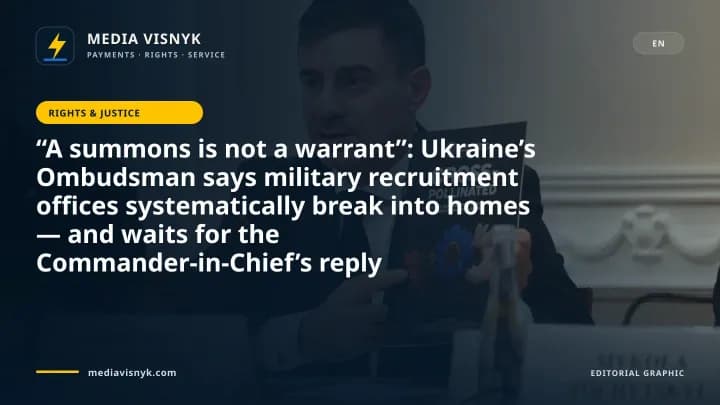
“A summons is not a warrant”: Ukraine’s Ombudsman says military recruitment offices systematically break into homes — and waits for the Commander-in-Chief’s reply

Mobilisation as a Cover for Abduction and Torture: Six Ukrainian Servicemen to Face Trial in Kharkiv