
Trump’s “energy ceasefire” lasted three days. Russia responded with a record ballistic attack on Kyiv: 5 dead, 600,000 without power
Russia’s most massive ballistic strike on Kyiv in weeks killed five people and left 600,000 without power, three days after Trump announced an “energy ceasefire.” Zelenskyy says partners gave no warning of the launches; Trump insists intelligence sharing never stopped.
 1 / 4
1 / 4Three days — that’s how long the “energy ceasefire” lasted. On October 11, President Donald Trump posted on Truth Social that both Ukraine and Russia had agreed to halt strikes on each other’s energy infrastructure. The Kremlin replied: “nothing to say.” Zelenskyy said Ukraine was ready if Russia agreed — and indeed, according to the president, Ukraine refrained from hitting Russian oil refineries for two days, honoring the terms.
Russia, meanwhile, was preparing its heaviest ballistic assault on Kyiv in recent weeks.
The attack began around 10:40 PM on October 13 and continued in six waves until about 8:00 AM on October 14. According to the Ukrainian Air Force, Russia launched 39 ballistic missiles (including Zircon hypersonic missiles) and 128 attack drones — a total of 167 aerial threats. Ukrainian air defense intercepted or suppressed only 4 ballistic missiles. Drone interception was more effective: 115 out of 128 (90%). But the ballistic component proved nearly unstoppable.
The primary targets were Kyiv’s energy infrastructure. Missiles struck TPP-4, one of the capital’s main power plants. In total, Zelenskyy reported damage to 26 elements of the power grid and 4 oil and gas facilities. All three of Kyiv’s thermal power plants were hit.
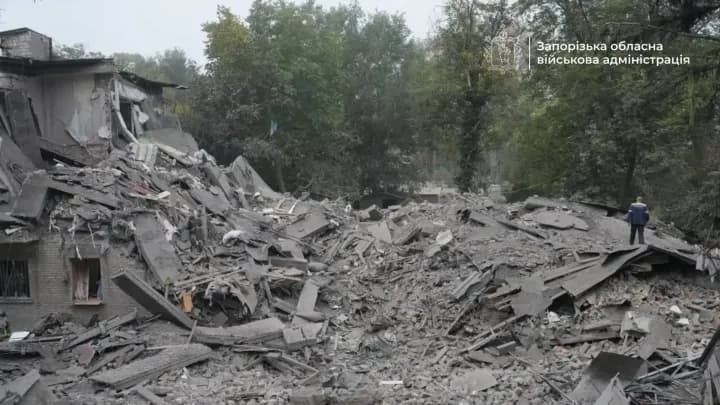
A missile hit a nine-story residential building in the Desnyansky district. Fire engulfed apartments from the first to the eighth floor. Sixteen residents were rescued. Three women — aged 35, 58, and 84 — were killed. Two more people died in the Holosiivskyi district. Among the wounded is a 7-year-old girl.
Emergency blackouts were imposed in five districts of Kyiv: Darnytskyi, Dniprovskyi, Pecherskyi, Solomyanskyi, and part of Holosiivskyi. Stabilization schedules are temporarily suspended. DTEK, the energy company, said crews are working but gave no timeline for restoration. At least 600,000 people are without electricity.
The key question: what about the “energy ceasefire”?
Zelenskyy called the attack “a demonstrative disrespect of Russia towards America, unlike anything before.” It’s hard to argue: striking the very infrastructure that the US president just declared off-limits is a deliberate message.
But there is another side. Zelenskyy stated that partners again failed to warn Ukraine about the ballistic launches. The Air Force confirmed: “no information from partners regarding launches from enemy territory was received.” Reasons are being investigated.
Trump responded quickly. On October 13, he told reporters: “No, we haven’t stopped. We’ve been helping them” — referring to intelligence sharing. This creates a classic contradiction: Kyiv says it received no warning; Washington says data is being shared. Who is right remains unclear. But the result is the same: missiles were detected only as they approached Kyiv, and people died.
Possible explanations include technical limitations — ballistic missiles from S-400 systems have very short flight times and are hard to track by satellite. But could there be a political decision behind the silence? Some Western media have suggested weather or satellite coverage gaps, but no official confirmation exists.
Another painful issue is air defense effectiveness. Only 4 out of 39 ballistic missiles were intercepted. Kyiv is supposed to be one of the best-protected cities in the world, with Patriot systems. Are they fully operational? Are there restrictions on their use? The authorities avoid direct answers.
Meanwhile, Kyiv braces for another night. Power may be partially restored today, but no guarantees. And crucially, there is no guarantee that Russia will not repeat the attack tomorrow. The “energy ceasefire” has proven to be a fiction. The war continues under old rules: Russia strikes, Ukraine defends, partners promise help.
The uncomfortable question for Ukraine’s leadership: do you truly believe Russia will honor any agreement without facing real consequences for violations? And why are we again learning about missile launches from explosions rather than from partner warnings?
Primary sources
Documents and statements this story is based on.
“Putin Doesn’t Read Truth Social”: The Energy Ceasefire as Theatre of the Absurd
‘Lifeline for Putin’: US Senators Accuse Trump of Violating Law Over Russian Diesel Imports
Trump’s ‘Energy Truce’ Unravels in Hours: Russia Strikes Power Grid in Three Ukrainian Regions, Six Dead
Burning Refineries at the Cost of Intelligence: Is the Gamble Worth It?