
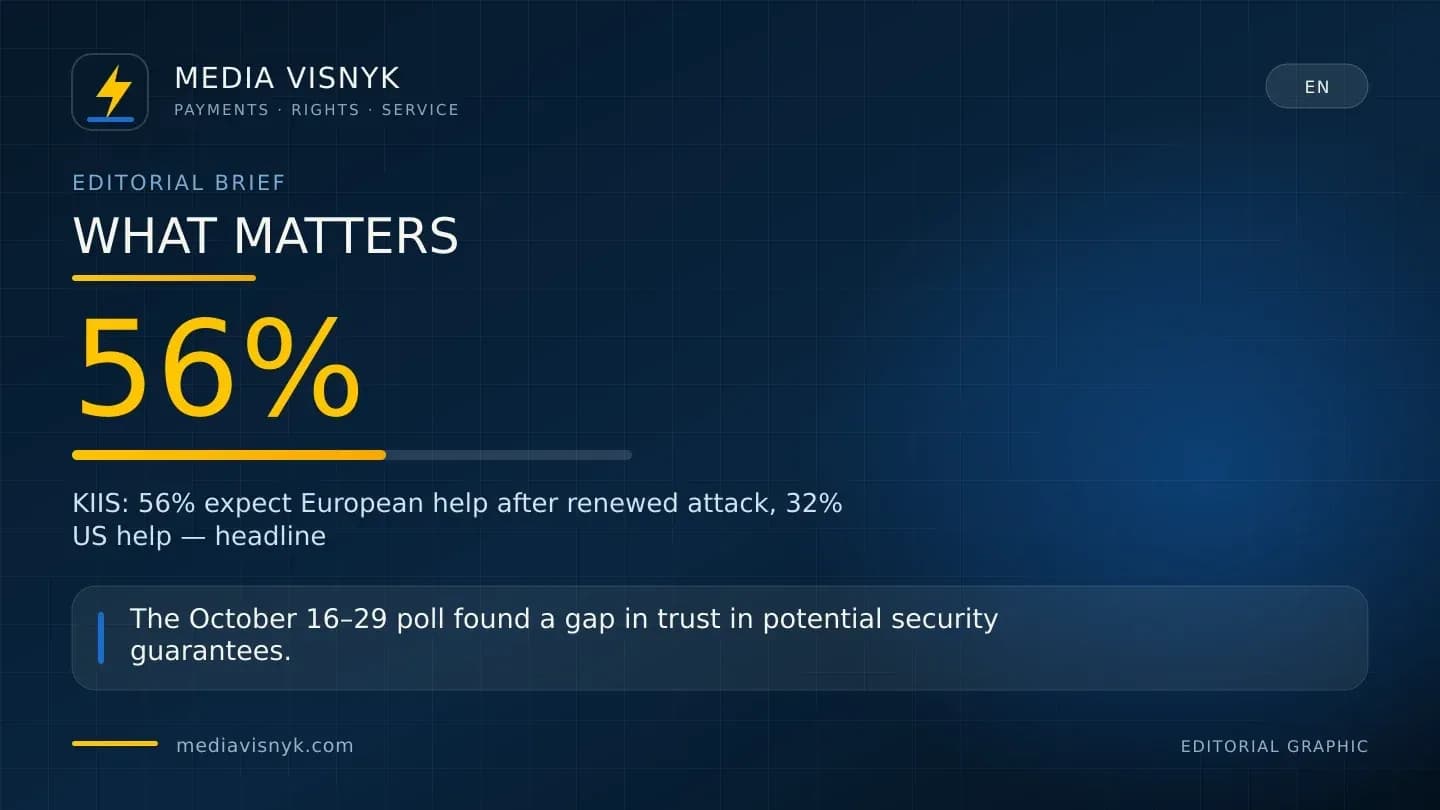
KIIS: 56% expect European help after renewed attack, 32% US help
The October 16–29 poll found a gap in trust in potential security guarantees. It concerns a hypothetical scenario, not an assessment of a specific agreement.
If Russia attacks again after a ceasefire, 56% of respondents expect Europe to provide Ukraine with the necessary assistance, assuming security guarantees have been given. For the United States, 32% hold that view. These are findings from a Kyiv International Institute of Sociology survey published on November 3, 2026. Fieldwork took place on October 16–29.
Respondents were asked to imagine a ceasefire along the current front line and security guarantees for Ukraine from the United States and Europe. They were then asked whether those partners would provide the necessary support to repel another Russian attack. The guarantees were not specified. The answers therefore reflect expectations in a hypothetical situation, not the existence of international commitments or a test of whether they are being fulfilled.
For Europe, 38% believe the necessary assistance would probably not be provided. For the United States, 54% gave that answer — more than half of respondents. The questionnaire specifically asked whether partners would be more likely to provide or not provide support, rather than about certainty of a particular outcome. Compared with April, the share expecting US assistance rose from 27% to 32%; assessments of Europe did not change substantially, according to KIIS.
A separate section concerned perceptions of partners’ current policies. Some 69% chose the statement that Europe continues to provide serious assistance to Ukraine and wants the war to end on terms acceptable to Ukraine. In contrast, 25% agreed with the statement that Europe is growing tired, its support is weakening and it is applying pressure for concessions to Russia. In May, those figures were 64% and 25%, respectively.
For the United States, the balance is reversed: 61% chose the statement about fatigue, weakening support and pressure on Ukraine to make concessions to Russia, while 30% chose the statement about continued serious assistance and a desire to end the war on terms acceptable to Ukraine. In May, the figures were 56% and 30%, respectively. These are respondents’ assessments, not facts established by the poll about the intentions of Washington or European countries.
Each participant answered both questions about partners’ policies, but the order varied: half were asked about Europe first and half about the United States. The order of the two proposed statements was also randomized. The questionnaire allowed for “hard to say” and refusal to answer, options that interviewers did not read aloud.
KIIS funded the study itself as part of its Omnibus survey: 1,017 Ukrainian citizens aged 18 or older, located in government-controlled territory, were surveyed using computer-assisted telephone interviews, or CATI. Mobile numbers were randomly generated, followed by statistical weighting. The sample excluded residents of occupied territories and citizens who had gone abroad after February 24, 2022; participants included internally displaced people.
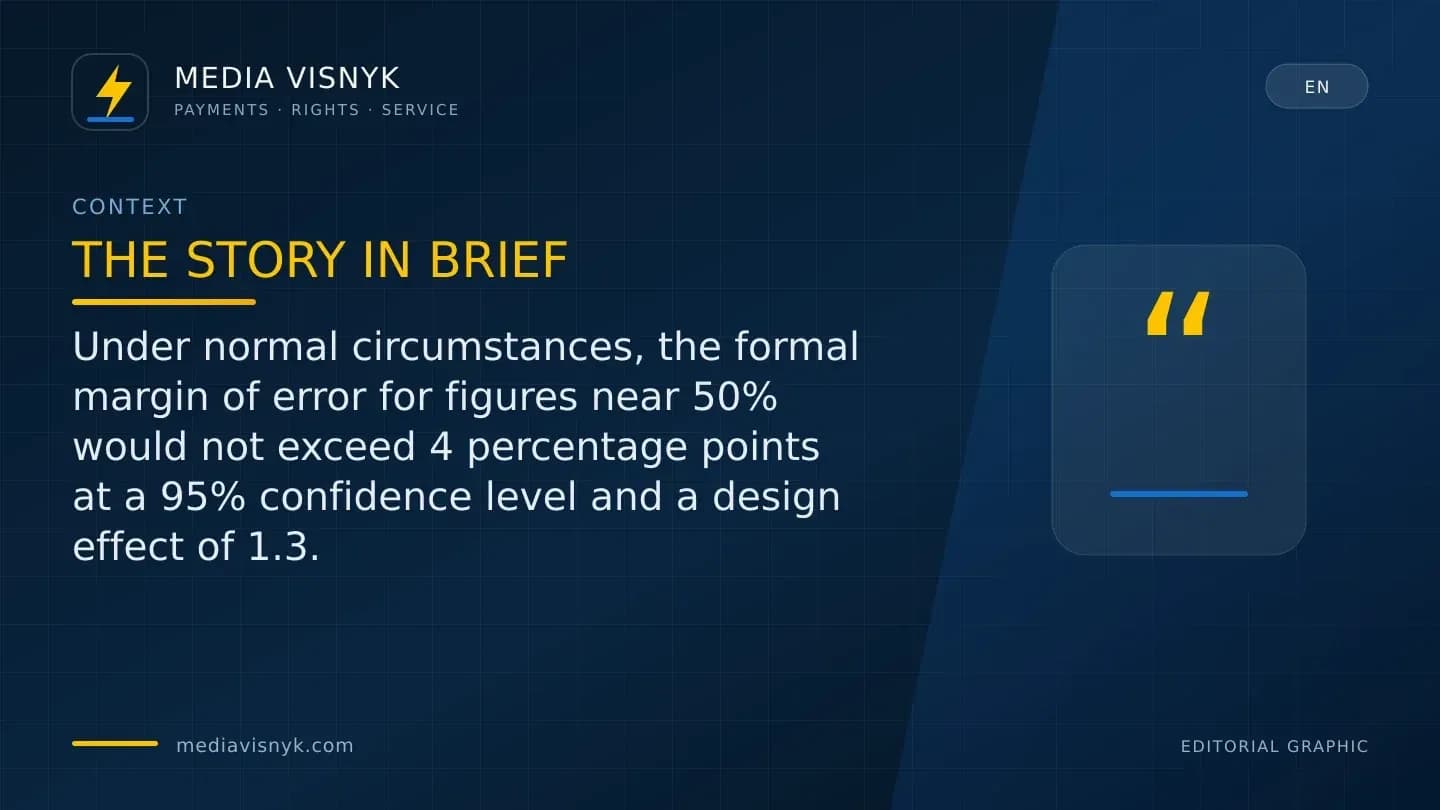
Under normal circumstances, the formal margin of error for figures near 50% would not exceed 4 percentage points at a 95% confidence level and a design effect of 1.3. The institute warns that wartime conditions introduce potential systematic biases. Percentages in the release are rounded to whole numbers, so totals may differ from 100%.
Primary sources
Documents and statements this story is based on.