
Zelenskyy’s Surrender: He Finally Told the Truth — Just Not the One We Needed
In a Bloomberg interview, Volodymyr Zelenskyy suddenly “saw” what he had publicly ignored for two years: the United States is pressuring Ukraine to capitulate. Trump is to blame, of course. But the real question isn’t whether America is leaning on Kyiv. The question is why Ukraine ended up in a position where such pressure is even possible — and who brought the country to this point.
 1 / 4
At 3 a.m. on October 19, Ukrainian news feeds exploded with the same headline: “Zelenskyy says the U.S. is pushing Ukraine toward capitulation.” Interfax, TSN, Dzerkalo Tyzhnia — all leading with the story. It sounds like a bombshell. The president publicly accuses his key ally of demanding surrender.
But let’s hold the applause.
Anyone who has listened to Zelenskyy over the past three years knows his “truth” has a curious habit of appearing just when blame needs to be shifted. Is Trump guilty? Absolutely. Trump is playing a game where Ukraine is a bargaining chip. Trump wants a “peace deal” on the Kremlin’s terms. Trump threatens to cut aid.
But who built relations with the U.S. solely on personal chemistry instead of institutional foundations? Who kept assuring everyone that “everything is under control” while the Biden administration trickled weapons and Europe just scratched its head? Who drove the country to a state where without American Patriots the air defense is a sieve, and without intelligence the army is blind?
Here’s the irony of the moment. Zelenskyy acts as if he’s just now, in October 2026, seen the light. As if there were no Munich speech by Trump, no open statements about “territorial concessions,” no closed-door consultations where Americans were already drawing demarcation lines. The president suddenly noticed the elephant in the room — and immediately blamed the elephant.
The second ironic detail: the proposal Zelenskyy presents almost as a diplomatic victory — “don’t strike Russian refineries in exchange for Patriots.” It sounds like a deal. In reality, it’s bargaining for survival. We don’t hit their oil infrastructure; they give us protection. Except Patriots are defensive weapons that don’t change the war’s trajectory. Giving up strikes on refineries is a real weakening of one’s own strategy. And this is sold as a negotiating win.
The third point is the logic of the accusations. Zelenskyy says: “Trump is pressuring us to surrender.” But didn’t the president himself create the conditions for that pressure? No clear Plan B, constant infighting in the Office of the President, a failed mobilization, an economy on the brink — and as a result, a weak hand at the negotiating table. When you depend on one ally for 80% of your military support, your voice carries exactly as much weight as that ally allows.
Now that Trump is exploiting that dependence to the fullest, Zelenskyy is outraged. But would it be different if Kyiv had its own missile program, its own air defense production, its own energy independence? It would not be. Because the entire previous policy was a story of burning through the credit of trust without building anything to replace it.
Yes, Trump is a cynical player. His “peace plan” reeks of capitulation. But when the president of a war-torn country comes out and says “they are forcing us to surrender,” it’s not a call to fight. It’s groundwork for a future excuse. “I wanted to keep fighting, but the Americans wouldn’t let me.” A convenient position. Especially if you don’t mention who signed the Istanbul agreements, who derailed talks in 2022, who promised “victory on the battlefield” — and didn’t deliver.
Will this interview change anything? Unlikely. Trump has already fired back with counter-accusations. The wave of discussion is rising. But the core remains unchanged: Ukraine is trapped in its own helplessness. And instead of offering a way out, the president chooses the easiest path — blaming the one who pressures. Because admitting one’s own mistakes is the real capitulation. Before the truth.
And apparently, no one is ready to accept that.
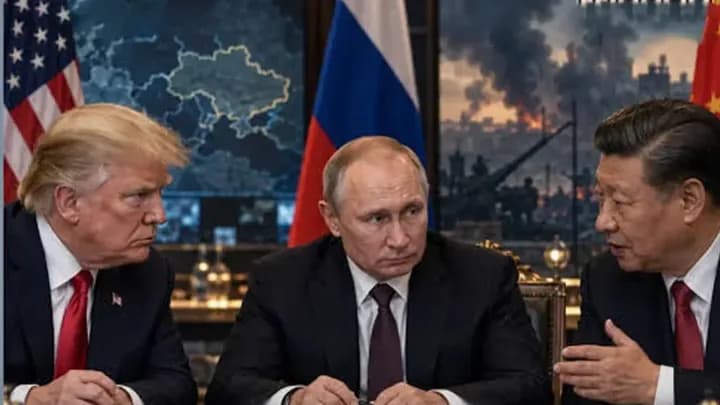
Putin Proposes Trump-Xi Summit on Ukraine Without Zelenskyy — WSJ
“Elect a New President”: Who Decides for Ukraine — and Why
Death at a Siberian Plague Lab: Russia Denies, WHO Demands Answers, Trump Calls Putin
Trump Wants the Nobel Peace Prize. For What? For the War with Iran and a “24-Hour” Promise That’s Four Years Old