Men Held for Weeks, One Chained to a Ladder: What Changed at a Ukrainian Recruitment Office
Ukraine's ombudsman says conditions improved at the Uzhhorod recruitment office. A court has also issued a torture conviction in one episode.
 1 / 4
1 / 4The Uzhhorod case offers a rare opportunity to ask what happens after serious abuse allegations at a Ukrainian Territorial Recruitment and Social Support Center, commonly known in Ukraine by the abbreviation TCC.
These centers administer military registration and mobilization. They do not, however, operate outside ordinary legal protections.
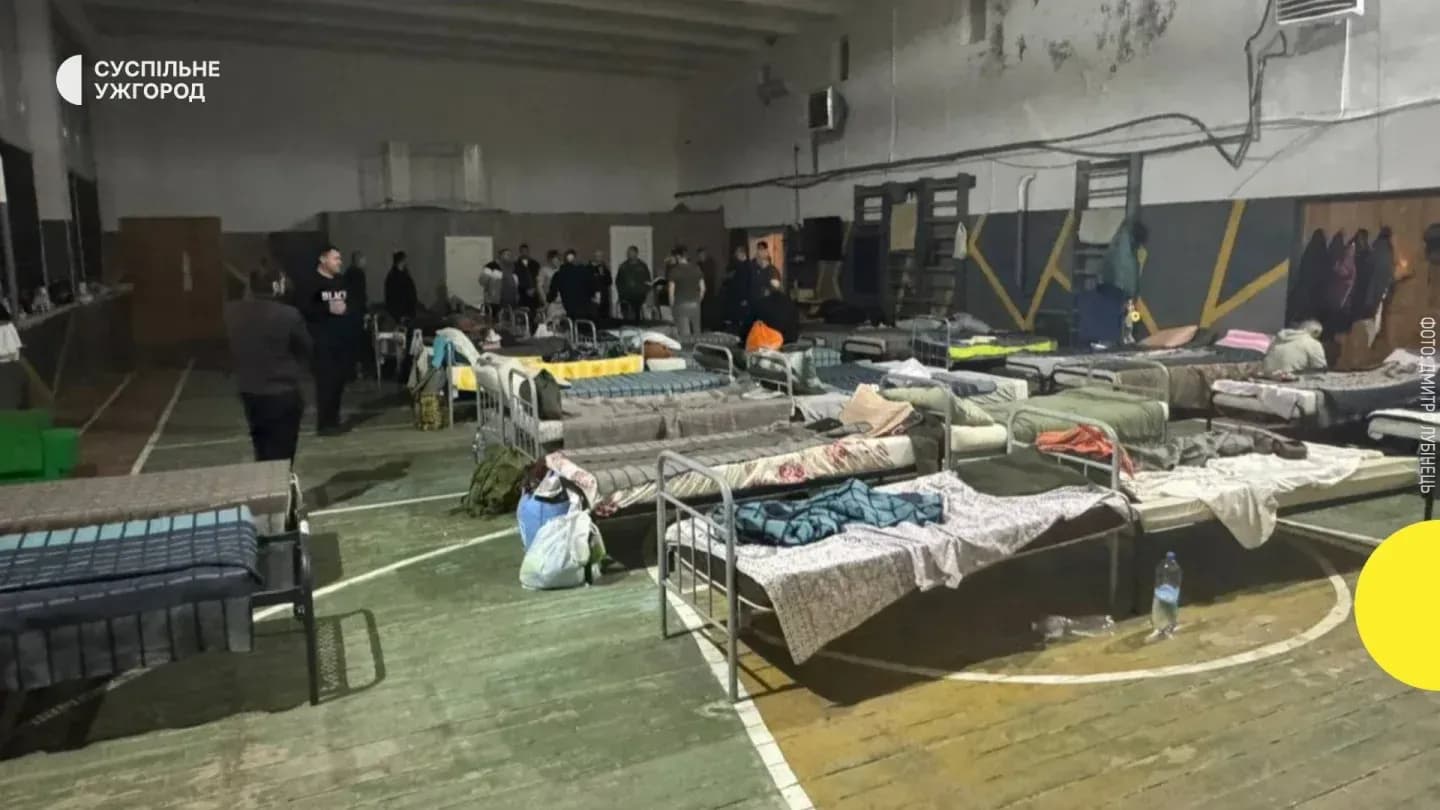
During an April monitoring visit to the Uzhhorod district TCC in western Ukraine's Zakarpattia region, representatives of Parliament's Commissioner for Human Rights reported people being kept there for weeks, poor sanitation, problems accessing medical treatment and restrictions on communication.
Ombudsman Dmytro Lubinets later said some cases lasted more than 50 days.
Investigators described a slightly different scope. Ukraine's State Bureau of Investigation said 21 men had been kept at a temporary mobilization facility without legal grounds after military units declined to accept them for service. The investigation cited periods ranging from one to 48 days.
The discrepancy matters. The over-50-day figure comes from the Ombudsman's monitoring findings, while the one-to-48-day range relates to the 21 men covered by the criminal investigation. Publicly available sources do not explain the difference.
The ladder episode is now a court case with a verdict
One incident went further than allegations.
Investigators said a TCC instructor used handcuffs to secure a man to a ladder and left him there overnight. The instructor was notified of suspicion of torture in June. Two TCC managers were separately suspected of abuse of authority and unlawful deprivation of liberty.
On September 1, the Uzhhorod City District Court issued a first-instance judgment in case No. 308/10575/26.
According to the judgment, the instructor handcuffed the man's right arm to a ladder on the evening of March 23 and left him in that position until the following morning. The defendant fully admitted guilt in court.
The court found him guilty of torture and imposed a three-year prison sentence.
It then released him from serving that prison term on probation for one year, concluding that rehabilitation was possible without imprisonment.
That judgment is not yet final. The court stated that it can be appealed within 30 days, and that period had not expired when this article was checked on September 11.
The case involving 21 men remains different
The two managers suspected in connection with the alleged unlawful detention of the 21 men have a different legal status.
In June, a court ordered the then acting head of the Uzhhorod TCC held in custody without bail. The head of a military-registration unit was also remanded in custody, with bail set at UAH 998,400.
As of August 6, public reporting said the investigation into the two managers was continuing. We did not find a reliable public source showing a final conviction against either of them by September 11.
They therefore remain suspects in that part of the case and must not be described as convicted.
What changed inside the center
During his return visit, Lubinets reported visible improvements.
The area where people had previously stayed in what was effectively a gym had been renovated. Food and material provision had been addressed, and CCTV cameras installed.
Those changes are meaningful.
But they answer only part of the problem.
Renovation addresses degrading living conditions. Cameras may provide an objective record of events. Better food addresses basic treatment.
None of those measures, by itself, answers the central legal question: can a person be prevented from leaving without a lawful basis and without effective access to legal assistance?
The Ombudsman's public account of the return visit did not disclose how many people were present, the individual legal basis for their continued presence, or whether monitors tested access to lawyers and relatives.
It also did not report new unlawful detention cases during the visit.
That means the public evidence supports a narrower conclusion: conditions have improved and at least one serious abuse episode has produced a court judgment. It does not yet prove that every practice that led to the original scandal has disappeared.
The real test is therefore not whether the former gym has fresh walls and cameras.
It is whether someone can ever again spend days or weeks inside such a facility without a clearly documented legal reason and immediate access to protection.
Primary sources
Documents and statements this story is based on.
- Office of the Verkhovna Rada Commissioner for Human Rights — return visit to the Uzhhorod district TCC
- State Bureau of Investigation — Uzhhorod district TCC case
- Ombudsman's Office — suspicion notices to Uzhhorod district TCC staff
- Court judgment in case No. 308/10575/26 (No. 139365795, dated 01.09.2026)
- Suspilne Uzhhorod — pre-trial restrictions and results of the first monitoring visit
- Suspilne Uzhhorod — first report on violations (April 4, 2026)
- Groza — status of investigations as of August 6