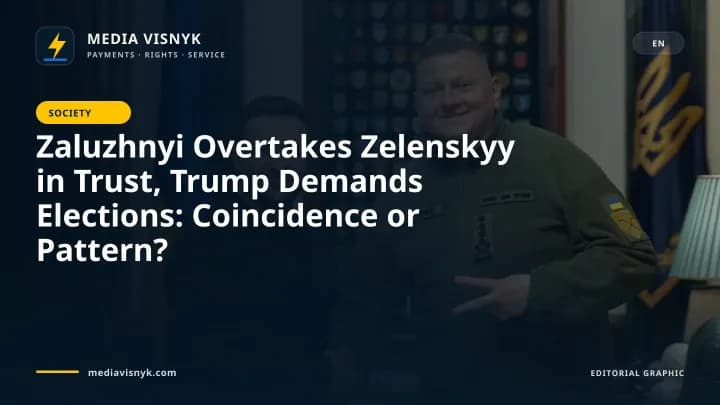
Ukraine 2026 Elections: The Government Fears the Ballot Box More Than the Enemy
Ukraine enters October 2026 with no election date in sight, but with plenty of rumors about candidates, ratings, and backroom deals. The government is once again using the war as a universal shield against political competition. This column is not a call for immediate elections — it asks who the Office of the President fears more: Putin or its own people.
 1 / 4
1 / 4October 2026. The calendar shows the fourth year of full-scale war, and the Constitution states that elections should have taken place last spring. But we have martial law, so — silence. Not the kind on the front line, but the kind in the information space: not a single official word about the country’s political future.
Instead, rumors. Someone says the President’s Office is already drawing up lists of “friends” and “enemies.” Someone else claims that approval ratings are classified even for internal use because “it’s not the time.” The irony is that it’s “not the time” for elections, but it is the time for billion-hryvnia budgets, mobilization campaigns, and appointments without any public discussion.
Elections are a luxury, not a right. That’s the unofficial creed of the current government. As long as the war continues, democracy can wait. But here’s the thing: if elections are a luxury, why isn’t the government even trying to create the conditions for this “luxury” to become possible? No public post-war transition plan, no draft laws on temporary voting for soldiers, not even a discussion about electronic voting. Just silence.
And here’s a paradox that’s hard to miss. The government constantly says: “We are fighting for democratic values.” But when it comes to the most basic democratic instrument — elections — we hear: “Not now, it’s dangerous, the enemy will take advantage.” So democracy is fine as a slogan, but not as a practice.
Compare the government’s readiness for elections with its readiness for mobilization. In the first case — zero. In the second — billions of hryvnias, hundreds of thousands of people, administrative pressure. A logical question arises: why is mobilization possible under wartime conditions, but elections are not? Don’t the soldiers on the front line deserve the right to vote? Aren’t people in frontline cities citizens?
Of course, there are arguments: security, the impossibility of holding elections in occupied territories, the risk of Russian interference. They sound convincing — at first glance. But dig deeper, and it becomes clear: these arguments are convenient for the government precisely because they allow it to avoid the main thing — political competition.
Because ratings are a state secret. Especially those that show declining trust in the incumbent president. Especially those that indicate a growing demand for new faces. And here’s the crux: the government isn’t just avoiding elections — it’s avoiding even talking about them. Because any conversation is an admission that political life exists, that there are alternatives, that people have the right to choose.
Instead — information sterilization. No debates, no public discussions of the future. Only “we are united,” “not the time for politicking,” “the enemy is waiting for us to quarrel.” But who said elections are a quarrel? Who said competition is weakness? In civilized countries, elections during war are not an anomaly — they are a challenge that is met. Here, they are a reason for postponement.
And so we are in October 2026. The front line is static, the economy is barely breathing, and the political system is in suspended animation. The government is not afraid of Putin — it has grown accustomed to him as a factor it can manipulate. It is afraid of the ballot box. Because the ballot box means unpredictability. It means the risk of losing power. It means having to answer to people who are tired, impoverished, and have lost loved ones.
So the answer to the question “who do they fear more?” is obvious. The government fears its own people. Because the people might say: “Thank you, but let’s try someone else.” And that cannot be allowed.
Will there be elections in 2026? Formally — no, if martial law is extended. But society is already starting to ask uncomfortable questions. And that’s good. Because even if there are no elections, the very fact of the discussion is a victory. A victory of common sense over fear. A victory of right over “luxury.”
For now — we watch. And we note: October 2026 — the month the government once again chose silence over an answer.