
They Came to Fight for Ukraine. Years Later, Some Still Lack the Documents That Prove It
An investigation published on 9 September shows how badly Ukraine's promise of equal rights for foreign contract soldiers can break down once paperwork goes missing.
 1 / 4
1 / 4The problem sounds almost too basic for a country fighting a major war.
A foreign national signs a Ukrainian military contract, serves on the front and may even be wounded. Years later, that same person can still struggle to obtain the records proving where and how he served.
Ukrainska Pravda's investigation gives the example of Gator, an American volunteer who first joined Ukraine's International Legion and later served with Chosen Company in the 59th Brigade.
After being wounded and undergoing lengthy rehabilitation, he is trying to return to Ukraine's Defence Forces. He told the newspaper that he never received a complete set of records from his former brigade, including his combat-veteran certificate.
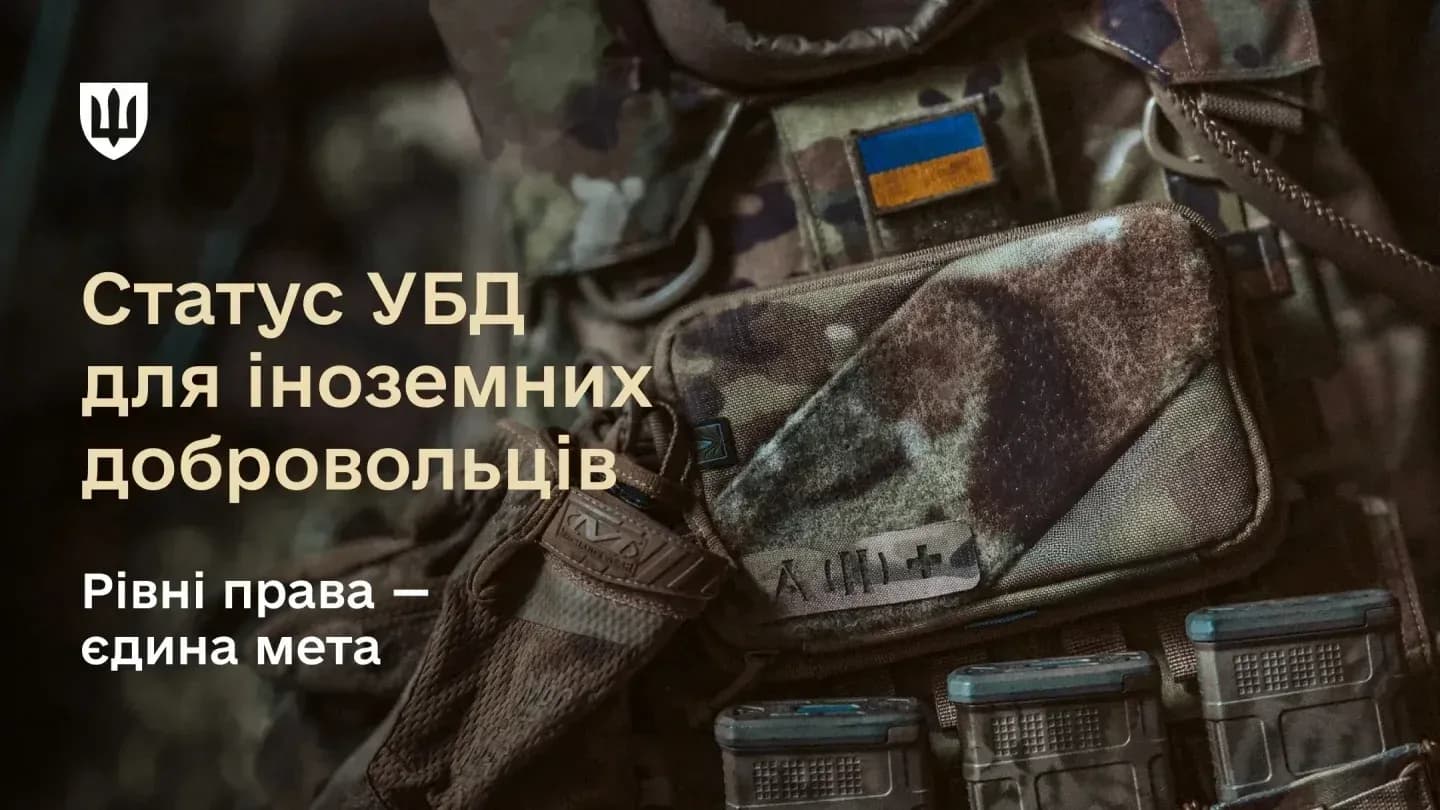
In Ukraine, that status is known as UBD — uchasnyk boiovykh dii, or participant in combat operations. It is a formal veteran status tied to state recognition and social guarantees.
Ukraine's Defence Ministry says foreign contract soldiers are entitled to it on essentially the same basis as Ukrainian service members. A foreign passport, by itself, is not a reason to deny the status.
The official procedure also shows why missing records matter so much.
For the automatic route, an authorised officer in a military unit is supposed to enter combat-task data into Ukraine's Unified State Register of War Veterans within five days of the beginning of the task. If automatic recognition is not possible, the case can go through a commission. A foreign soldier may also submit an application personally — but still needs official documents establishing service and combat participation.
That creates an obvious Catch-22.
You need military records to prove what the military did with you. If the unit failed to create, preserve or hand over those records, the burden can end up back on the soldier.
The consequences extend beyond veteran status.
Since 10 May 2026, Ukraine has had a new temporary-residence procedure for foreign troops serving under contract in the Armed Forces, National Guard and State Special Transport Service. The permit can cover the entire contract plus six months after service ends. The Defence Ministry says the application requires, among other things, a military service identity document and the contract itself.
For a foreign fighter, paperwork is therefore not an administrative luxury. It can determine whether other parts of the Ukrainian state can recognise the person's legal status at all.
The alleged UAH 25,000 “document fee”
The most explosive allegation in the investigation concerns money.
Gator told Ukrainska Pravda that some members of Chosen Company were allegedly asked to pay UAH 25,000 for what was presented as a service fee connected with their paperwork. He says he paid twice after being told the first set of documents had been lost.
That allegation must be handled carefully.
Ukrainska Pravda explicitly says it could not independently verify all circumstances surrounding the payments. There is currently no published investigative or judicial finding establishing that a corruption scheme existed.
The 59th Brigade told the publication it had heard about the alleged payments for the first time from the journalists. The brigade said it would examine the information and, if evidence of criminal conduct emerged, refer the material to Ukraine's State Bureau of Investigation or another competent investigative body.
So the confirmed fact is not that soldiers were subjected to a proven extortion scheme.
The confirmed fact is that a soldier has made the allegation, journalists disclosed its evidentiary limits, and the brigade has promised to investigate it.
Why 300-plus complaints change the picture
One missing file can be a local administrative failure.
More than 300 complaints in roughly six months suggest a problem that deserves a broader answer.
According to the figures cited by Ukrainska Pravda, foreign troops complained most often about missing service or veteran-status documents, inadequate medical care or support, and problems affecting the families of missing, killed or deceased foreign personnel. Some relatives struggled to receive official notification or assemble the paperwork needed for benefits.
Ukraine is already trying to redesign the system for new foreign recruits.
On 4 July, the government announced a unified support mechanism covering a volunteer's journey from arrival in Ukraine to signing a military contract. Approved private companies are supposed to handle logistics, documents, insurance, accommodation and other pre-contract needs. The government says payment to a company can total UAH 300,000 per recruited candidate, disbursed in stages.
There is nothing inherently improper about that model; the government's stated purpose is precisely to create a more transparent and controlled recruitment process.
But it creates an uncomfortable contrast.
Ukraine is building a professional, publicly regulated support pipeline for future foreign recruits while some people who already fought in earlier years are still trying to reconstruct the paper trail of their service.
The new system does not automatically repair those older cases.
Foreign volunteer does not automatically mean “mercenary”
That distinction is becoming internationally important.
A UN Working Group on the use of mercenaries conducted a mission to Colombia in March 2026. Its preliminary findings said the group had been told that more than 10,000 Colombians may have been recruited abroad for different military, security and armed-conflict roles, with Ukraine among several countries mentioned.
But the UN experts also stressed that poor data often makes it impossible to determine who is a voluntary enlistee, a contractor or a mercenary.
International humanitarian law treats “mercenary” as a specific legal category, not a synonym for any foreign soldier.
Article 47 of Additional Protocol I to the Geneva Conventions sets out cumulative criteria, one of which is that the person is not a member of the armed forces of a party to the conflict. Foreign citizenship alone therefore does not satisfy the legal definition.
The UN Working Group says its full Colombia mission report will be presented to the UN Human Rights Council in September 2026.
Ukrainska Pravda, citing diplomatic sources, reports that the forthcoming document may contain critical references to conditions faced by foreigners serving in Ukraine. That is not yet an official UN finding: the report had not been published when this article was checked.
Ukraine's Foreign Ministry spokesman Heorhii Tykhyi told the publication that Kyiv had contacted the Working Group's secretariat, asked for the Ukrainian position to be reflected and invited the experts to visit Ukraine to examine individual cases.
That response matters.
The strongest defence of Ukraine's international reputation would not be to pretend that every complaint is hostile propaganda. It would be to identify which complaints are substantiated, repair the administrative failures and investigate the serious allegations that can actually be proven.
A foreigner who volunteered to fight for Ukraine should not have to fight a second battle simply to prove that he did.
Primary sources
Documents and statements this story is based on.
- Ukrainska Pravda — “Seven rounds at training and years without combat-veteran status. What problems foreign volunteers face”
- Ministry of Defence of Ukraine — “Combat-veteran (UBD) status for foreigners: rights and the procedure for obtaining it”
- Міністерство оборони України — порядок временного проживания иностранных военнослужащих
- Cabinet of Ministers of Ukraine — support mechanism for foreign volunteers
- UN Working Group on the use of mercenaries — Preliminary findings, Colombia mission, 16–27 March 2026
- International Committee of the Red Cross — Additional Protocol I, Article 47