
‘I’m completely alone’: viral video of a child after his father was taken by a Ukrainian recruitment centre raises a harder question
A viral video shows a boy saying his father was taken by a TCC and that he is now alone. Verified facts are scarce, but the case raises real questions about sole-parent mobilisation exemptions and the state’s duty to protect a child left without care.
 1 / 4
1 / 4On August 21, the Ukrainian outlet ANTIKOR published a report about a video circulating on social media and in local online communities. In the footage, a crying boy says his father was taken away by TCC personnel and that his mother is absent. Passers-by and a neighbour are seen trying to calm him. According to the child’s account, his father had been the parent raising him.
There is, however, a major factual limitation.
The publication does not identify the father, establish the exact filming location, explain why he was taken to a recruitment centre, confirm whether police were involved, show whether he had a registered mobilisation exemption, or establish that he was ultimately drafted into military service. The outlet itself stated that detailed official information about the case was unavailable.
As of September 10, we could not find a public statement from police, a TCC, child-protection authorities or Ukraine’s ombudsman identifying this particular father and son or explaining how the incident ended.
That means the viral footage cannot responsibly be turned into a definitive claim that “a sole father in Odesa was unlawfully mobilised and his child abandoned.”
It does, however, raise a legitimate legal question: what would the law require if the child’s account were accurate?
Being the parent who actually raises a child is not always enough
Ukraine’s mobilisation law exempts certain parents of children under 18 from compulsory mobilisation.
Article 23 covers cases where the other parent has died, been deprived of parental rights, been recognised as missing or absent, declared dead, or is serving a prison sentence. It also covers a person who independently raises and supports a child where that status has been established by a court decision.
That creates an important distinction between everyday reality and legal status.
A father may in practice be the only parent feeding a child, taking the child to school and making every daily decision.
But “the mother left,” “the mother lives elsewhere,” or “the mother is abroad” does not automatically establish the mobilisation exemption.
Cabinet Resolution No. 560 specifies documents used to confirm the relevant grounds, including a death certificate, specified court rulings, missing-person documentation or a prison judgment. For independent child-rearing, the procedure expressly recognises a court decision establishing that fact.
Ukraine’s own human-rights ombudsman described a strikingly similar problem in February 2026.
A 14-year-old boy in Kryvyi Rih was temporarily placed in a social and psychological rehabilitation centre after his father was mobilised. According to Ombudsman Dmytro Lubinets, the father had in fact raised his son alone since 2022 while the mother lived abroad. But the sole-parenting situation had never been legally formalised, despite earlier advice from child services to put the documents in order.
The comparison does not prove anything about the father in the viral video.
It does demonstrate why the legal status matters.
If the man shown in the viral story had a valid and verifiable ground under Article 23, he should not have been conscripted through mobilisation.
If the child’s mother merely lived separately while retaining her legal parental status, and no other statutory ground or court ruling existed, the legal position could be very different.
We currently do not know which situation applied.
Could the TCC simply ‘detain’ the father?
Another source of confusion is the tendency to use “document check,” “notification,” “delivery to a TCC,” “administrative detention” and “mobilisation” as if they were interchangeable.
They are not.
Ukraine’s mobilisation procedure under Resolution No. 560 provides for police officers to participate in notification activities alongside TCC representatives. It assigns administrative detention and delivery to police in specified circumstances, including certain military-registration offences and cases involving relevant wanted-person information.
So the claim that “a TCC can simply detain anyone it chooses” is too broad.
The opposite claim — that recruitment-centre personnel have no role at all in procedures that may lead to a person being delivered to a TCC — is also misleading.
A legal assessment requires specifics: who restricted the person’s freedom, whether police were present, what legal ground was recorded and what happened after the person reached the recruitment centre.
The viral video does not supply those answers.
The father’s paperwork and the child’s protection are two separate obligations
There is a strong practical lesson for parents who genuinely raise children alone: their legal status must match the family’s real circumstances.
Ukraine’s ombudsman has explicitly warned that failing to formalise sole-parenting arrangements can leave both the parent and the child without effective legal protection during mobilisation.
But that is only half the story.
A parent’s failure to complete paperwork does not relieve public authorities of their responsibility toward a child who is actually left without parental care.
Ukraine’s child-protection procedure requires a children’s service receiving such a report to determine the child’s whereabouts, obtain information about the parents or substitute caregivers and establish the circumstances in which parental care was lost. Information received by local authorities must be transferred to the children’s service without delay.
That distinction is crucial.
A neighbour may comfort a distressed child.
A passer-by may stay until the child stops crying.
But informal help does not answer the legal question of who is responsible for the minor, where the child will stay and whether a relative or another authorised adult is available.
If the boy in the footage truly had no parent or legal caregiver available after his father was taken away, the situation required more than sympathy on the pavement.
It required authorities to determine whether the child had been left without parental care and, if so, to activate the child-protection mechanism.
There is still no public account showing whether that happened in this case.
Two other child-related incidents involving TCC personnel in the Odesa region are independently confirmed
The viral video should not be presented as part of a single chain of Odesa offences without evidence linking the cases.
But two separate incidents in Odesa and the surrounding region during August and September have been officially documented.
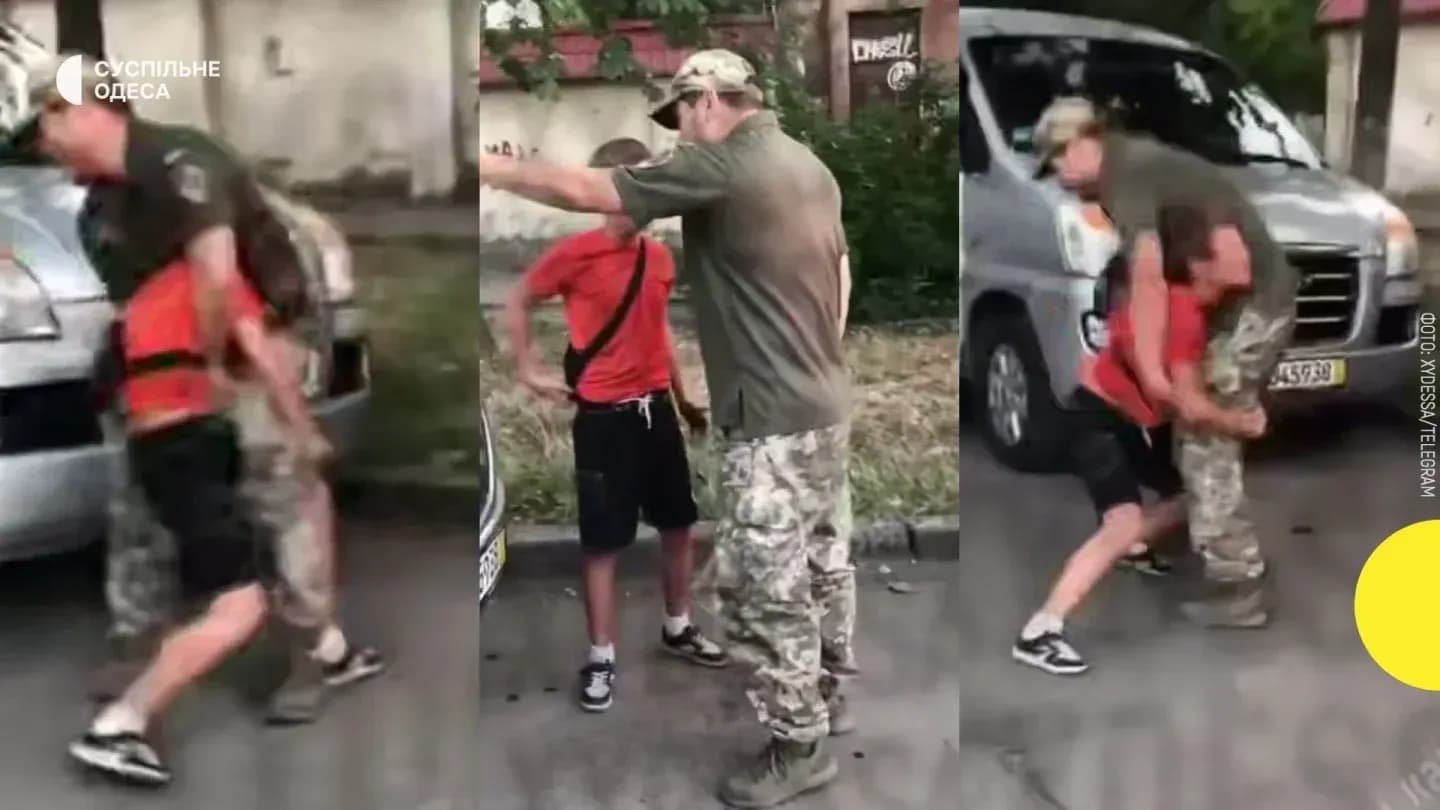
On August 18, footage circulated showing a man in military uniform using force against a 13-year-old boy in Odesa. The Odesa regional TCC announced an internal review and said violence, abuse of authority and improper treatment of citizens were unacceptable. Police opened a criminal investigation.
On August 20, Odesa’s Khadzhybeiskyi District Court considered a request to place a 37-year-old district TCC serviceman in custody. He is suspected under criminal-law provisions concerning alleged beatings and unlawful restraint of the 13-year-old. According to the court, investigators allege that he struck the boy and forcibly held him.
An important correction is necessary here.
Some secondary reports described the decision as the suspect being “sent to pre-trial detention with bail available.” The court’s own statement says the custody request was only partially granted and bail itself was imposed as the preventive measure. At the time of the court notice, the ruling had not yet become final and could be appealed. The suspect has not been convicted.
A second incident occurred on September 3 in the Balta community of Odesa region.
Regional police said a district TCC employee conducting mobilisation notification activities drove over a two-and-a-half-year-old boy after the child moved away from his father, then left the scene. The child was hospitalised. Police registered proceedings under Criminal Code provisions concerning road-safety violations and leaving a person in danger, and said the driver was being detained under criminal procedure.
The boy’s father later told Suspilne that a confrontation with a TCC employee and a police officer had immediately preceded the collision. That is the father’s account, not a fact established by investigators. An Odesa regional health official told the broadcaster that the child’s condition was assessed as mild and that he was receiving inpatient treatment for multiple superficial head injuries.
These incidents do not prove a single organised practice or policy.
They do show why safeguards around children cannot be treated as an abstract concern when mobilisation activities take place in public spaces and around families.
Mobilisation powers do not erase child-protection duties
Ukraine has the legal authority to mobilise eligible citizens.
Military-liable citizens have legal obligations concerning registration.
TCCs have statutory functions.
Police have powers to detain people in circumstances defined by law.
None of that means the presence of a dependent child becomes legally irrelevant the moment a parent is taken away.
The reverse is equally important: the sight of a crying child does not by itself prove that the father’s detention or mobilisation was unlawful.
Both issues have to be investigated separately.
What was the legal basis for taking the father?
Who did it?
Were police involved?
Did he qualify for an Article 23 exemption?
Was that status properly documented and verifiable?
And once officials became aware that a child might be left without a caregiver, what was done to protect the child?
The viral video answers none of those questions conclusively.
That is precisely why the lack of a public follow-up matters.
Nearly three weeks after the clip was published, the most basic question remains unanswered in public: who made sure that the boy who said he was “completely alone” did not, in fact, remain alone?
Primary sources
Documents and statements this story is based on.
- ANTIKOR — ‘I’m completely alone’: boy bursts into tears after his father is detained by TCC personnel
- Law of Ukraine ‘On Mobilisation Preparation and Mobilisation’
- Cabinet of Ministers of Ukraine Resolution No. 560
- Ukrainian Parliament Commissioner for Human Rights — ‘Mobilisation of single fathers’
- Suspilne Odesa — incident involving a 13-year-old boy
- Khadzhybeiskyi District Court of Odesa — preventive measure for an RTCC and SSS serviceman
- National Police in Odesa region — road accident in Podilsk district
- Suspilne Odesa — road accident involving a TCC employee
- Cabinet of Ministers of Ukraine Resolution No. 866 — protection of children’s rights